» home
» about
» membership
» branches
» journal
» information
» forum
» sparoza
» members' gardens
» notice-board
» news & views
» seed exchange
» in bloom now
» contact
» make a donation
» site map
MGS OFFICERS
President
Jean Vaché
Vice President
George Brumder
Secretary
Jane Taniskidou
Treasurer
Jill Yakas
Councillor
Caroline Harbouri
Reserve Members
Heather Martin
Christine Savage
Fulla Chapple
Journal Editor
Caroline Harbouri
Custodian of the MGS Garden
Sally Razelou
Web Consultant
Jon Watts and
Truetype Web Solutions
Past Presidents
Sally Razelou
Heidi Gildemeister
Katherine Greenberg
Cali Doxiadis
Caroline Harbouri
See also:
List of Branch Heads
To learn about how the MGS got its start, see:
A Short History of the MGS
See also:
Mediterranean Gardens
An interview with Cali Doxiadis, past President of the Mediterranean Garden Society.
Making a Garden on a Greek Hillside
A review of the book by Jackie Tyrwhitt describing the original garden at Sparoza and how to order it
|
About the MGS
The Mediterranean Garden Society (MGS) is a non-profit making association founded in Greece in 1994 which acts as a forum for everyone who has a special interest in the plants and gardens of mediterranean climate regions. The forum operates through the quarterly journal, The Mediterranean Garden, with articles and book reviews almost exclusively written by members; this constantly up-dated web site; and, on a more local level, through events organised by branches formed in the countries where our members live and garden. The principles espoused by the MGS are demonstrated for the members’ benefit in an experimental garden just outside Athens on a property belonging to the Goulandris Natural History Museum and generously placed at our disposal.
The aims of the MGS as set out in the Charter were deliberately drafted broadly to cover all possible directions that the society might wish to go in its life. As an international society, the MGS has members in countries throughout the world and in many of them members have formed branches so that they can meet for various activities.
*NB The word "Mediterranean" with a capital M is used to denote the countries surrounding the Mediterranean Basin, while the uncapitalized word "mediterranean" is used to describe the type of climate shared by these countries and other regions of the world.
Why a 'mediterranean' garden society?
For many years gardening literature has been dominated by descriptions and illustrations of plants and garden designs suited to the climate of northern Europe and other temperate zones where so far there is no lack of water. Seduced by these images, mediterranean gardeners have struggled to produce approximations to 'English gardens' which are quite unsuited to the conditions of the mediterranean climate areas.
It is the goal of the Mediterranean Garden Society to develop alternatives, no less attractive or alluring, which are truly based on a mediterranean way of gardening. The plants to be used, as natives to the mediterranean climate areas of the world, will of necessity be more or less drought resistant. Waterwise gardening has to be one of the basic tenets in countries where summer drought can last for four months and more - areas where the cost of water can only increase and availability decrease.
A further principle is the protection and nurturing of the existing flora. A mediterranean plot where trees and shrubs grow slowly and tortuously is no place for fashionable 'make-overs'. Mature, existing trees offer immediate shade to both people and new plantings, and wildflowers lighten up the spring garden without any effort on the part of the owner. With a little flexibility existing plants can be worked into the design of the new garden.

A new garden in an almond grove using stones from the
plot for edging and mediterranean plants.

A mature garden in an olive grove using the same materials.
In fact the design of the garden is where the principles of mediterranean gardening are rooted. Instead of rolling lawns and beds of plants all bursting into flower at once in the summer, a mediterranean garden is a more complex collection of hard surfaces of local natural and man-made materials, shaded areas, water features and plants flowering in turn for all twelve months of the year. In some parts of the garden scent will be more important than flowers for the number of mediterranean plants with scented leaves is amazing: not only herbs but geraniums, salvias, helichrysums, tanacetums and many more. Again, plant shape can be an important design feature, for instance many native mediterranean plants have a naturally cushion-like shape while the small leaves of plants like box, Pistachio and Teucrium fruticans make them ideal subjects for clipping.
Finally, the special needs of garden maintenance have to be faced. These centre on the subject of soil improvement, much more through mulching and composting than through digging.
The Mediterranean Garden
All these topics and many more feature in articles in The Mediterranean Garden, the journal which members receive four times a year and which is the major advantage of membership. The Editor, Caroline Harbouri, depends very largely on contributions from members who write from personal experience both of their own gardens and of the gardens and the countryside that they have visited. The articles are illustrated by drawings and the journal also includes book reviews, letters and news.
The MGS Garden at Sparoza
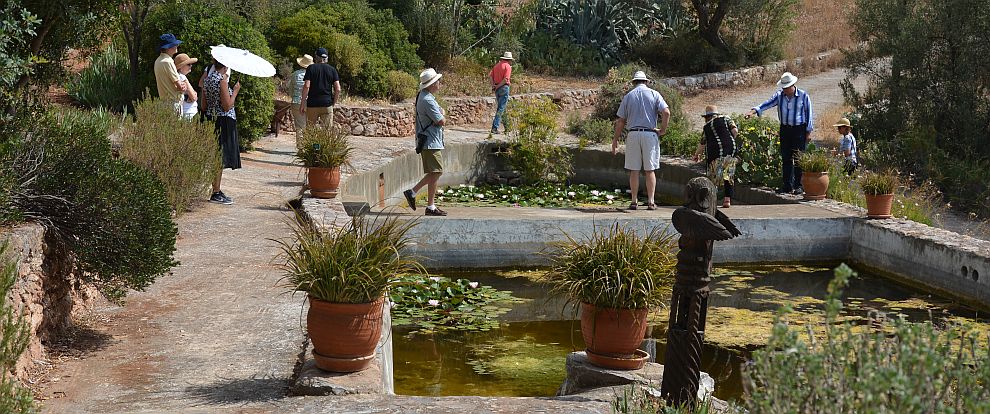
In the 1960s Jaqueline Tyrwhitt, an English city planner, started to create a garden on a dry, stony hillside in Attica, Greece. On her death in 1983 she bequeathed her house and garden to the Goulandris Natural History Museum. It was here in 1994, with the permission of the Museum, that a group of gardeners conceived the idea of a mediterranean garden society. Thus the legal headquarters of the society are at Sparoza and the garden has become the embodiment of the MGS principles. The planting is a mixture of mediterranean plants that are indigenous to Greece and other mediterranean countries. Plants are propagated in the nursery and are available to members. There is also a growing library of journals and books on gardens, plants and horticulture. Sally Razelou, founding member and first MGS President, is the custodian of the garden and has improved and extended it tremendously since she came to live at Sparoza in 1992. For several years now she has welcomed students who are anxious to increase their knowledge of mediterranean plants and gardening to be resident at Sparoza and work under her supervision. Members of the society are invited to visit (by appointment) to talk to the custodian and to get ideas and encouragement.


Views of the garden and hillside at Sparoza.
They can also join the group of volunteers who work one day a week on the maintenance of the garden. (Please contact the Greek Branch Head for information about volunteering.)
Members
From the beginning it was envisaged that gardeners from all the mediterranean-climate regions of the world would want to participate in the MGS - from the countries surrounding the Mediterranean Sea and from California, Australia and South Africa which, with humid winters and long hot and dry summers, have climates similar to the Mediterranean. Members living in more northern climes join the MGS because of a general interest in mediterranean plants or because they have a second home and garden in a mediterranean area. Once a year a large number of members gather together for the Annual General meeting which is accompanied by a few days of excursions. Old friends meet up and new friendships are made.
The Web Site
The MGS has moved slowly but steadily into the internet age. Members can now check what branch events are happening in the coming months, consult the seed list for a free order of seeds, post a message on the Members' Notice-board and renew membership on-line. All gardening enthusiasts can find out about the MGS, its journal and its garden, read informative articles about members’ gardens, plants, climate, etc and keep up-to-date with questions set to the 'experts'. The Web Editor Jean Vaché and the Web Manager Jon Watts are constantly working on ways to improve the site.
Members
From the beginning it was envisaged that gardeners from all the mediterranean-climate regions of the world would want to participate in the MGS - from the countries surrounding the Mediterranean Sea, and from California, Australia and South Africa which, with humid winters and long hot and dry summers, have climates similar to that of the Mediterranean.
Although registered in Greece, the MGS uses English as its main language so as to be accessible to as many people as possible internationally. To encourage membership among mediterranean gardeners whose first language is not English, the MGS has in the past published articles in the journal in other Mediterranean languages and produced an anthology of articles in Italian. Our most recent innovation is to set up web sites in other languages giving information about the MGS and about mediterranean gardening. So far the French site and the Greek site are online.
Members living in more northern climes join the MGS because of a general interest in mediterranean plants or because they have a second home and garden in a mediterranean area. Once a year a large number of members gather together for the Annual General Meeting which is accompanied by a few days of excursions. Old friends meet up and new friendships are made.
Branches
The Society has a number of active regional branches that independently plan their own activities ranging from lectures and demonstrations to garden visits and expeditions to areas of floral interest. Members visiting a different area are welcome to join in local events if places are available. The Branch Heads work both to provide an interesting programme of events for the members in their area, to promote the principles of the MGS among the general public and to encourage new members to join the MGS.
Officers
The Mediterranean Garden Society is administered entirely by volunteers, both at the central and at the branch levels. There is no paid staff; fees paid are for technical help in publishing the journal, managing the website and producing financial statements for the tax office and General Assembly.
Membership
Membership to the MGS is open to all. Annual subscriptions are payable on 1st January and new members joining throughout the course of the year will receive all four issues published in that year. Joint membership at a reduced rate is available for partners who require only one journal and there is a reduced subscription for students.
Members who would like to have a copy of the English translation of the MGS Charter, or who have any questions about the MGS, please get in touch with the Secretary.

A garden on an olive tree.
Photographs by Fleur Pavlidis, Terry Moyemont,
Davina Michaelides and Michelle Torres-Grant.
|