The
Mediterranean Garden Society


» home
» about
» journal
» branches
» membership
» news & views
» notice-board
» events
» gardens
» seed exchange
» contact

BRANCH HEAD
John Joynes
Ithakis 17, Kolossi
Limassol 4632, CYPRUS jcjoynes@cytanet.com.cy


The Cyprus Branch of the MGS

Forthcoming events

Saturday 15th March 2008 
Visit to 2 nurseries specialising in Cactus & Succulents (Christina Pieri Djama Garden Centre, Dherynia and Cactus Island, Paralimni.)

This visit is a follow-up to the excellent talk given by MGS member and co-founder of the Cyprus Cactus & Succulent Society, Mary Michaelides. With the desperate water situation that we are currently experiencing in Cyprus this may be the way for our gardens to go in the not-too-distant future. Plants like the ones in the photos, (Aloe arborescens and Aeonium arboreum var atropurpureum), may become even more common than they already are. For more details contact the Branch Head.

Photos by John Joynes

Information

The plant in the photograph below may not look particularly spectacular but it is none the less special.  Centaurea akamantis is an extremely rare Cyprus endemic that is confined to one small area in the Akamas region.  It was only discovered within the last 15 years, by a government forester.  Needless to say it is strictly protected by the articles of the Bern Convention.  I hasten to add that I acquired my specimen legally.  The Agricultural Research Institute is carrying out trials to assess it for garden use and I got it from them.
John Joynes


Centaurea akamantis

Past events

Visit to Strakka olive plantation 3 May 2008
The Strakka organic olive plantation is situated on the outskirts of Lefkosia (Nicosia), sandwiched between the suburbs of Lakatamia and Dheftera. To property developers it is seen as prime land for housing but, fortunately, the owners are determined to resist any pressure and would much prefer to see the estate declared a National Park than be built upon. The land has been in their family since 1942 but its history can be traced back much further, at least 500 years, to the Venetian occupation of the island. The name Strakka dates from that time and means a place of recreation and relaxation. It was used by the Venetian owners as an area for hunting and generally "chilling out" away from the confines of the city.

Since 1942 the present owner’s family has grown citrus, olives and vines at various times. Currently the estate grows a mixture of citrus alongside 7,000 olive trees of four different varieties. The estate became fully organic in 1999 and having received their certification, a process that takes three years, have been able to market their produce as organic since 2003. The olives are cold pressed and the oil from the four varieties are blended to produce an oil of good colour and flavour. The total output of the estate is exported to the UK, none is sold on the local market. The General Manager, Andys Pentayitis, gave the MGS members a very informative and interesting tour of the plantation and also the storage areas, explaining the reasoning behind each procedure involved in the final production.  He also told us of their latest venture, to produce two aromatic oils, one of lemon and the other of orange, using organically grown citrus, of course. As we left Andys very kindly gave everyone a bottle of the lemon flavoured oil to try with a request to report their opinion after trying it.

Using succulents in Mediterranean gardens, a personal experience
MGS member, Mary Michaelides, is a succulent enthusiast. This enthusiasm is shared by her good friend, Elena Alonefti, and together they recently founded the Cyprus Cactus & Succulent Society. (I'm pleased to report that their optimism was well founded and their society has got off to an excellent start). Mary began by growing succulents in containers before deciding to attempt to integrate them into her garden. Gradually, her traditional square of grass surrounded by herbaceous borders was transformed into a succulent garden. This transformation was the subject of her presentation, ' Using Succulents in Mediterranean gardens, a personal experience', given on Saturday 6th October 2007 at the Acropolis Park, Nicosia. Mary still grows succulents in containers, she has over 200 of them, but her imaginative and artistic use of them as garden plants alongside more conventional drought tolerant ones has created a garden that is both aesthetically attractive and water-wise. Mary's presentation was greatly appreciated by all who attended and opened many eyes to the fact that cacti and succulents deserve better than to be considered as a separate entity used solely in containers or 'desert' gardens.

House of Roses
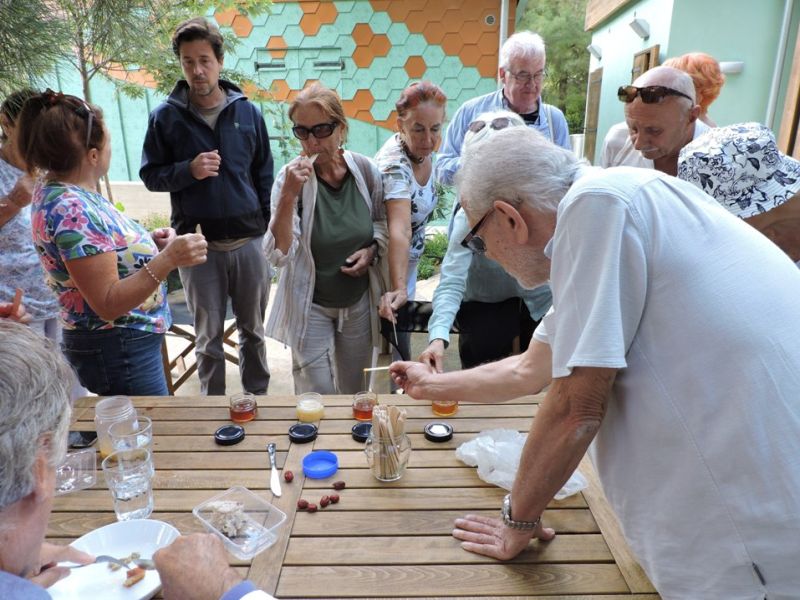
Agros is the Rose village of Cyprus. Rosa damascena in particular is grown and harvested there for the manufacture of assorted rose-scented products.  On Saturday 19th May twenty members and guests of the Cyprus Branch paid a visit to the House of Roses to see the process for themselves. May is harvest time with groups of workers setting out at dawn to gather the blossoms. These must be picked before the sun becomes too hot and destroys much of the essential oil. Needless to say we did not witness this but arrived at a more respectable hour after the blooms had been collected and were undergoing the distillation process. On arrival our lady members were invited to experience the sensation of 'lying on a bed of roses'. The techniques involved in producing the various items were explained and the products sampled; rose wine and liqueur internally, rosewater and assorted creams and potions externally.


Some of our lady members lying, or at least sitting, on a 'bed of roses'.


Gathered flowers of Rosa damascena


Exhibits in the Rose Exhibition.

Visit to Olympic House, Nicosia
On Saturday 28th April 2007, 22 members of the Cyprus Branch, plus a visiting UK member, met outside the Olympic House in Nicosia. This is a new complex built to house the offices of various sports federations involved in the Olympic movement.  Currently there are 36 sports represented. The gardens surrounding the building were designed and planted by MGS member, Yiannos Orphanos, who was present to explain his design concept and choice of plants.

Five areas along the front of the building have been delineated and designated to represent the five continents.  Each area is planted with a formal block of a single species, e.g. Tulbaghia violacea for Africa and a gold-leafed Duranta repens for South America.  Gravel in the colours of the Olympic rings, red, blue, green, yellow and black, enhances each area.  These squares are mirrored at the rear of the building, except that here a variety of plants from the subject continent are planted in a more naturalistic setting.  To one side of the complex plants from Greece, home of the Olympic Games, blend into ones from Cyprus, including several endemics.  At the opposite end an avenue of 36 olive trees, one for each sport, divides the building from the car park.

Altogether an imaginative and well thought out design that Yiannos hopes to improve upon over time as he sources more country-specific plants either to add or to replace existing ones.

Branch visit to Athens, April 2007


The photo shows members of the Cyprus Branch at Chrysanthi Paragou’s
nursery during their recent visit to Athens.


At the MGS garden at Sparoza members of the Cyprus branch were given a guided tour by Sally Razelou.

2nd Anniversary Meeting
The Cyprus Branch held its 2nd Anniversary Meeting at the Oleastro Olive Mill and Museum on Saturday 27th January.  Twenty-one people attended, of whom 16 were members, 66% of the total membership of the island.  If the members who sent apologies, due to illness, work commitments or absence from the island, were taken into account the figure would rise to 95%.  We may be small but we're enthusiastic!

Post AGM Meeting
The Cyprus Branch had scheduled a Post AGM Meeting to be held on Sat 4th Nov 2006 at the Elysium Hotel, Paphos. However, a change of managerial staff heralded a change of policy and we were cancelled. The Plateia Cafe in the Aphrodite Hills Golf Complex was chosen as a short notice replacement venue. This is an open air, though covered, coffee bar area and fingers were crossed regarding the weather as Cyprus has been experiencing unseasonal storms since mid-October. The rain was more than welcome although it did cause serious problems in some quarters due to its intensity and duration. Sat 4th dawned wet and windy but gradually brightened during the morning and, by the time of the meeting, improved to dry and windy. Unfortunately this didn't happen in time for one of our mountain dwelling members who was unable to attend due to low-lying cloud cover making driving extremely hazardous if not impossible. We still had a turn-out of 13 members (with apologies from 7) accompanied by 7 partners/friends. A commendable number given the adverse conditions.
John Joynes

Spring visit
The meeting was held on Saturday, 20th May at the Happy Valley House Cafe and Garden near the village of Skarinou in the Larnaca District. The cafe is situated opposite Sahin Nurseries which are owned and run by MGS member Leif Helstrom. It was here that the day began with Leif and his manager Nikos explaining the history and function of the nursery. Basically it is a wholesale concern - importing some plants and propagating others - that supplies flower shops and garden centres around the island. A tour of the poly-tunnels followed with members filling assorted trays with chosen plants as they progressed. Two hours later came the reckoning with wallets, purses and calculators to the fore. Plants safely loaded into cars we retired to the breeze-cooled patio of the cafe for much-needed refreshments. Poly-tunnels in May can be very dehydrating! The Meeting proper was conducted whilst waiting for food orders to be prepared. We had been warned in advance that this process might take a little time. The wait was worth it and was enlivened by the repartee of the owner, who can best be described as a 'character'. Those members to whom this was a new experience agreed that it was one they would be repeating in the not too distant future.

The idea of arranging visits to individual members gardens was raised at the meeting and will be pursued. Members will be notified of any developments in the usual manner.

Return trip to the Water-lilies
On Saturday 6th May 2006 12 members of the Cyprus Branch gathered in Psemilophou. This small village, just to the south-west of Lefkosia (Nicosia), is where Andreas Protopapas grows and breeds his award winning water lilies.

For the majority this was a second visit, the first, in August 2005, having inspired them to create a water feature, however small, in their own gardens. This return trip was with the express purpose of acquiring plants to stock these.

The choice was large and difficult and Andreas was kept busy delving into tanks and even donning waders to plunge into the larger ponds to collect selected specimens. A most enjoyable morning ended with everyone heading home with heads full of planting advice, plastic bags full of dripping water lilies and assorted containers full of mosquito fish!


Nymphaea 'Moorei' ('Mooreana').
Photograph by John Joynes

Agricultural Research Institute
On Friday 31st March 2006 the Branch paid a visit to the Agricultural Research Institute of the Ministry of Agriculture, Natural Resources and Environment. Our host Dr Dora Chimonidou began by giving a brief slide show presentation outlining the set-up and aims of the Institute. This was followed by a tour of some of the Departments in order to see at first hand the work being carried out.
Floriculture - here they are using Damask roses (Rosa damascena) in an attempt to re-introduce fragrance to some of the more bland varieties of hybrids. They also have an ongoing programme of evaluation of native plants for garden use.
Entomology - their Plant Protection programme is working on Integrated Control and Biological Control Systems in an attempt to reduce the dependence on chemical control.
Engineering - are experimenting with different techniques for drying various fruit and vegetables. They are also carrying out comparison research into the energy levels produced by a range of bio-mass materials.
Molecular Biology Laboratory - to see the state-of-the-art equipment they are using in the detection of and protection against plant and animal pathogens.
Altogether an eye-opening glimpse into a small part of the fascinating work being undertaken by a group of dedicated scientists and auxiliary staff.
A more detailed article on the above visit is planned for a future edition of the Journal.

First Anniversary
The Cyprus Branch came into being exactly a year ago in January 2005. In order to mark the occasion the members met at the same venue, The Wine Museum, Erimi, on Saturday 28th January 2006. Plans for the coming year were discussed in a relaxed atmosphere over cheese and wine. Altogether a pleasant social gathering that may possibly become a traditional event.

A waterwise golf course
A golf course may not be the obvious place for a gardening group to visit but that's what the Cyprus Branch did on Friday 9th December 2005. Indeed, the Aphrodite Hills complex turned out to be much more than just a golf course. Covering 240 hectares in total, on both sides of a deep valley, the site includes a large hotel and 2 villages, one with a village square of shops, restaurants and even a chapel. Our main interest, however, was the extensive landscaping that had been carried out employing mostly native and drought-tolerant plants and using a muted palette of mainly blues and yellows. We were particularly gratified to discover that an increasing amount of water for irrigation (especially of the fairways, greens, etc) was provided from the complex's own, underground, sewage treatment plant. If golf courses must be created in water-hungry countries, then this one at least was attempting to limit the impact on its local environment.
John Joynes

A new garden on a razed site
The winter rains hit Cyprus with a vengeance on Friday 18th and Sunday 20th November. Severe thunderstorms accompanied by torrential downpours turned roads into raging rivers, causing traffic chaos and mayhem island-wide. Luckily, sandwiched between these two extremes, Saturday 19th shone bright, clear and sunny and was the day the Cyprus Branch had arranged their latest visit. Landscape designer and MGS member Yiannos Orphanos had asked one of his clients for permission to show us around her garden. The prospect of having 20 total strangers wandering around your garden is fairly daunting but the lady of the house was totally unfazed and gave us a warm welcome.
The garden had only been created this spring, final planting having been completed in July, but everything had apparently established well and showed a maturity beyond its age. The site had been flattened and scraped clear by the house builders and Yiannos' first task was to attempt to create some interest using different levels. Several large stones/boulders that had been removed from the site and abandoned nearby were recovered and utilised to great effect. Yiannos' planting throughout used drought-tolerant plants, many of them Cyprus natives, such as Thymus capitatus and Cistus sp. In one very neat touch he had combined the indigenous Pistacia terebinthus with the tree named after it, Schinus terebinthifolius (Brazilian pepper tree). His unusual use of Horsetails (Equisetum) drew a lot of attention but even that couldn't compare with his lawn area - not the usual high maintenance grass but a native broad-leafed variety (Phyla filiformis). Tough, springy and spreading, it needs little water, rarely ever needs mowing and remains green through even the harshest summers.
This garden, though not large, is an excellent example of what can be achieved using native plants, even some that may be considered as little more than weeds.
John Joynes


Yiannos Orphanos, centre, introduces the garden he has recently designed and planted to members of the Cyprus branch.


A lawn created with a native plant, Phyla filiformis, surrounded by beds of drought resistant plants.

A water-lily expert in Cyprus
If you wanted to find a world-renowned authority on water-lilies, Cyprus would probably not be high on your list of places to look. However, it is here that Andreas Protopapas, an electronics engineer by profession, has pursued his hobby for the last 20 years. During this time he has honed his skills in growing and breeding water-lilies, introducing a number of new hybrids in the process. He has supplied the Royal Horticultural Society with examples of these for use in their gardens at Wisley and only recently has earned a major honour from the United States. In the International Water-lily & Water Gardening Society Annual New Water-lily Competition, Andreas was awarded top prize in the hardy water-lily category for his entry: Nymphaea 'Maria'.
So when the Cyprus Branch of the MGS was offered the chance to meet Andreas and to visit his facilities we realised it was an opportunity not to be missed. On the morning of Saturday 6th August a small but enthusiastic group met at the village of Psimolophou, to the south-west of Lefkosia (Nicosia), full of anticipation and questions. After an extremely pleasant and highly informative visit we left much wiser and even more enamoured of the beauty of water-lilies than when we arrived. Being August, many of the 150 varieties that Andreas grows had finished flowering and preliminary arrangements were made for a return visit next year, around May/June, when the majority should be at their best. This should also allow those members who were unfortunately unable to attend another chance to meet this remarkable man and his beautiful plants.
John Joynes

A Nursery to suit Cypriot gardens
'O Dendros' nursery, near Nisou village on the southern outskirts of Lefkosia, is owned by MGS member, Yiannos Orphanos. It is from here that he runs his landscape design business. Yiannos specializes in creating gardens suited to the harsh climate and poor soil that the majority of gardeners in Cyprus have to contend with. He is a man who knows his subject and his plants and is totally committed to passing on the message regarding the use of drought-tolerant and native plants whenever the opportunity arises.
So, when 27 members of a combined MGS/University of the Third Age Gardening Group descended on his nursery on a Saturday in June he was typically unfazed and ready to answer all questions. A detailed tour of the nursery provided enough fascinating information about each plant to cause writer's cramp and brain overload.
A light lunch in a local establishment, accompanied by a cold beverage of choice, allowed time for rest and reflection before our return to the nursery for the serious decision making. Which of those, "I know exactly the place for that" or "That's just what I've been looking for" to buy... As the cars were loaded everyone seemed to agree that it was good to find a nursery, and a nurseryman, that concentrated on plants that would survive the local environment and not on 'flashy exotics', that look fine in the 'Garden Centre', but rapidly decline when exposed to the harsh reality of the real world.
The photos show Yiannos explaining the pros and cons of individual plants to the group.

Branch visit to Amiandos Mines reforestation area
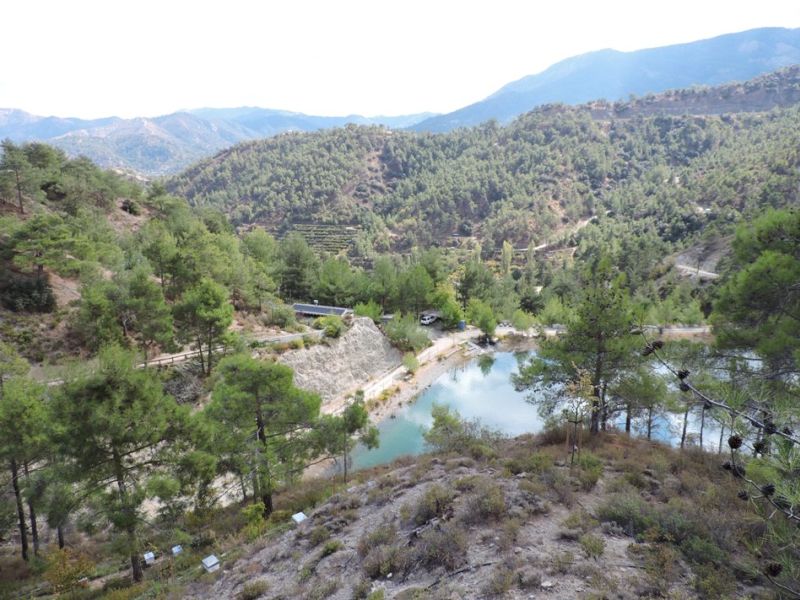
Asbestos mining was carried out in Cyprus for over 80 years, ending as recently as 1988. The excavations left a huge scar on the landscape and the extraction process rendered the remaining soil sterile.

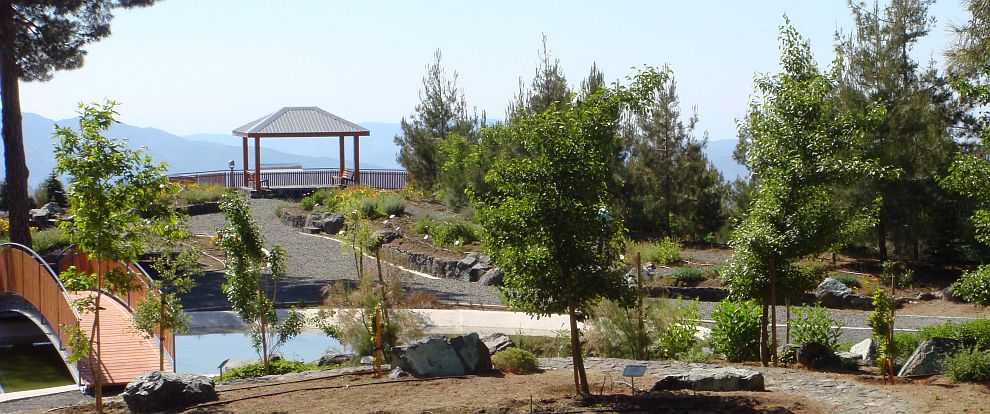
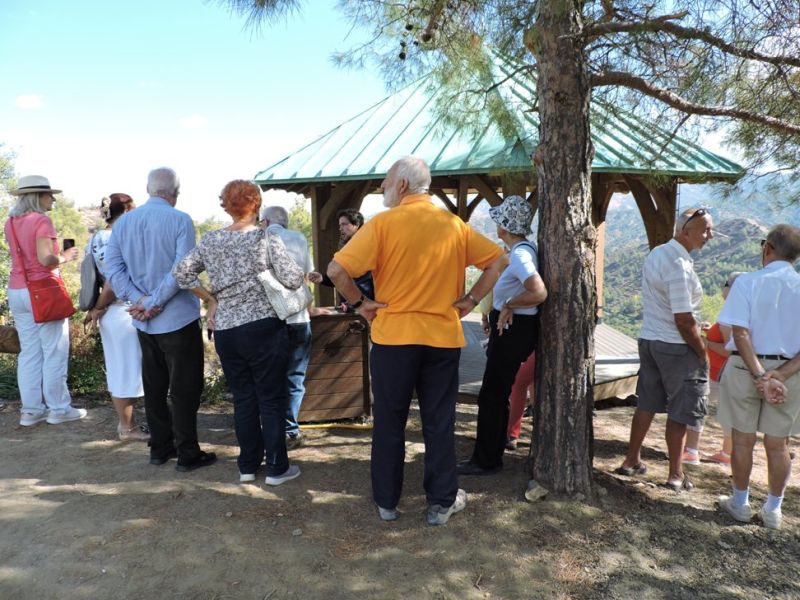
On the 23rd Apr 24 members, partners and guests of the Cyprus Branch were given a guided tour of the work being carried out, primarily by the Forestry Dept, to repair the damage. Our guide, Forestry Officer Dinos Georgiades, gave a detailed and informative presentation of the methods, plants used and financial cost of the operation. He also showed us the site of the proposed Botanical Garden that will feature native, especially endemic, plants. The main work on this is due to begin in the autumn and hopefully will be completed within a year.

Following the visit refreshments were taken at a café a little way down the mountain, overlooking a narrow gorge with a small stream. This provided an opportunity for members to get acquainted and discuss what was a successful first Branch outing.


Tulipa cypria, a Cyprus endemic. Painting by George Sfikas


Alyssum troodi, a Cyprus endemic           Thymus integer, a Cyprus endemic


The Mediterranean island of Cyprus is the home of a new branch under Branch Head John Joynes.

John came to horticulture late in life and had never even owned a garden until he settled in Cyprus. He grew up in Derbyshire in the 1950's before leaving to spend 22 years with the RAF serving in a variety of posts in the UK, Singapore, Berlin and Cyprus. A spell as a civilian with the West Yorkshire Police followed before, needing a change of pace, he enrolled as a mature student at Capel Manor College, Enfield, Middlesex for a one-year National Certificate course in Horticulture. In 1997 he returned to Cyprus to put down roots and to attempt to catch up on lost time, horticulturally speaking. Perhaps because of this he admits to suffering from that great gardening sin, impatience.

John Joynes

www.MediterraneanGardenSociety.org
All content (c) copyrighted by source or author, not to be reproduced without authorization.


see also gardening in mediterranean climates worldwide


This website is maintained by Truetype Web Solutions