Rainfall and watering at Sparoza
by Sally Razelou
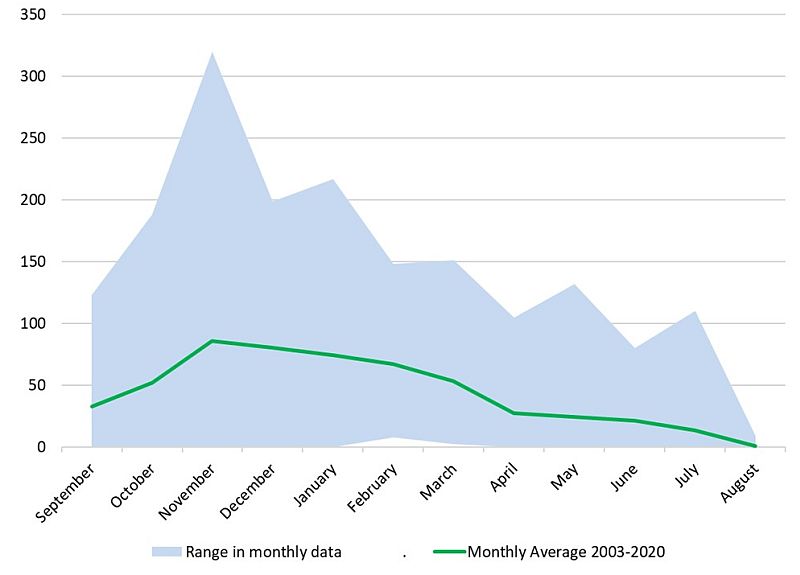
We are all familiar with the basic characteristics of the mediterranean climate: a hot, dry summer and rainfall concentrated in the winter months. Yet the unpredictability of the month-by-month rainfall is less often mentioned. This is one of the things that makes mediterranean gardening so fascinating.
I have been measuring and recording the rainfall at Sparoza for several years and present below the figures for 2003 to autumn 2009. Over six years the average annual rainfall at Sparoza was about 555mm. However, annual averages by no means tell the whole story. The year 2003/2004, for example, was remarkable for the fact that no rain at all fell in September and October 2003,followed by no rain at all from April to October 2004. Similarly July 2005 and July 2009 were exceptional for their rainfall (63 and 22mm respectively) since this is usually a completely dry month. No rain fell in January 2007, although there was snow.
Mediterranean plants are prepared for the dryness of the summer months but are subject to great stress if the autumn rains arrive late, as in 2003, or if the winter rainfall is exceptionally low. This was seen in winter 1999/2000 (figures not included below) when only 190mm of rain fell and we were watering the garden of Sparoza in February. In 2000 the spring flowers failed to appear on the hillside. Plants are also in trouble if the first autumn rains are followed by a month or more of drought. This occurred in autumn 2008: 33mm of rain fell in three consecutive days in the third week of September, encouraging plants into new growth, after which no more rain fell until half-way through November.
Rainfall at Sparoza in millimetres
Over eight years the average annual rainfall at Sparoza was about 616 millimetres.
|
2003/4 |
2004/5 |
2005/6 |
2006/7 |
2007/8 |
2008/9 |
2009/10 |
2010/11 |
SEPT |
0 |
0 |
91 |
45 |
0 |
33 |
32 |
42 |
OCT |
0 |
66 |
20 |
188 |
135 |
0 |
101 |
102 |
NOV |
69 |
59 |
320 |
52 |
38 |
65 |
50 |
64 |
DEC |
78 |
189 |
29 |
27 |
65 |
75 |
103 |
38 |
JAN |
217 |
129 |
98 |
0 snow |
29 |
75 |
52 |
54 |
FEB |
15 |
116 snow |
46 |
71 |
22 snow |
56 |
64 |
148 |
MAR |
21 snow |
33 |
62 |
80 |
83 |
101 |
15 |
31 |
APR |
12 |
2 |
17 |
10 |
76 |
37 |
3 |
75 |
MAY |
0 |
23 |
0 |
132 |
3 |
5 |
13 |
48 |
JUN |
0 |
7 |
0 |
21 |
0 |
3 |
16 |
24 |
JUL |
0 |
63 |
0 |
0 |
0 |
22 |
10 |
0 |
AUG |
0 |
0 |
0 |
0 |
0 |
0 |
0 |
0 |
TOTAL |
412 |
687 |
683 |
626 |
451 |
469 |
458 |
639 |
These figures show the very great variability of month-by-month rainfall over a period of eight years.
Some parts of the garden at Sparoza are watered, including of course the nursery and plants grown in pots. Other parts are left unwatered, including 'Derek’s Garden', the border round the 'threshing floor' (since 2008) and the hillside (with the exception of newly planted trees which receive water during their first year).
During the early part of the year, this water comes from the well. However, as a result of the increased building on the Sparoza hill the well now runs dry every year by late spring or early summer, after which mains water (the urban water supply that also serves the house) is used. There is no separate meter so it is not possible to distinguish between water used in the house and water used in the garden, but the following table gives the total consumption of mains water from 1999 to 2008.
Consumption of water from mains (urban water supply) at Sparoza
for the years 1999 to 2008
in cubic metres.
Year |
m3 |
Notes |
1999 |
219 |
|
2000 |
231 |
|
2001 |
174 |
|
2002 |
356 |
Watering of 90 trees planted on the hillside |
2003 |
250 |
|
2004 |
325 |
A leak in old piping from the reservoir; uncertain how much water was lost before the leak was mended |
2005 |
262 |
|
2006 |
239 |
|
2007 |
173 |
|
2008 |
151 |
|
The following lists show the plants at Sparoza that receive no summer water at all.
Those marked with an asterisk survive the dry months with no sign of stress. I have not marked the drought-deciduous species with an asterisk, although of course they are unstressed since they are dormant in summer. If one is not familiar with this drought-resisting strategy of summer dormancy, these plants might appear to be dead – but they come back to life and put out new leaves with the autumn rains, just as do the native geophytes which are abundant at Sparoza.
Drought-deciduous species:
Euphorbia acanthothamnos
E. dendroides
Clematis cirrhosa
Medicago arborea
Prasium majus
Sarcopoterium spinosum
Plants with foliage adaptations:
Ebenus cretica
Euphorbia characias
Phlomis fruticosa
P. italica
Ptilostemon chamaepeuce
Teucrium fruticans
Plants with grey foliage to resist drought:
Anthyllis barba-jovis
Artemisia arborescens
A. californica
*Atriplex halimus
Ballota acetabulosa
Convolvulus oleifolius
Coronilla valentina
*Dorycnium hirsutum
*Eriocephalus africanus
*Helichrysum thianschcanicum
Lavandula allardii
L. angustifolia
L. dentata
L. ‘Goodwin Creek Grey’
Limoniastrum monopetalum
Phagnalon graecum
Salvia chamaedryoides
S. officinalis
Santolina chamaecyparissus
Teucrium polium
Shrubs and trees that are evergreen:
Acacia cyanophylla
Brachychiton sp.
Bougainvillea sp.
*Bupleurum fruticosum
*Buxus sempervirens
*B. balearica
Ceratonia siliqua
*Cneorum tricoccon
Cotinus coggygria
Cupressus sempervirens
Eucalyptus globulus
Grevillea robusta
*Juniperus communis
*J. oxycedrus
*Myrtus communis
Nandina domestica
Olea europaea
*Phillyrea latifolia
Pinus halepensis
P. pinea
*Pistacia lentiscus
*Quercus coccifera
*Retama raetam
Rhamnus alaternus
Rosmarinus sp.
*Ruscus aculeatus
*R. hypoglossum
*R. hypophyllum
Ruta graveolens
Santolina viridis
*Teucrium flavum
Deciduous trees:
Ailanthus altissima
Cercis siliquastrum
Jacaranda mimosifolia
Melia azederach
Morus alba
Parkinsonia aculeata
Pistacia atlantica
P. vera
Punica granatum
*Ulmus parvifolia
Cacti and succulents:
Agave sp.
Aloe sp.
Crassula sp.
Cotyledon orbiculata
Haworthia sp.
Opuntia sp.
Sedum sp.
Yucca sp.
|