Mediterranean Garden Society
Mediterranean Garden Society
The Victoria Branch of the MGS
The objective of the Victorian branch is to give MGS members some value locally, in addition to the benefits they receive internationally. To this end, we aim to hold four to five events each year and send out an electronic newsletter with a similar frequency. Most of the local events are visits to private gardens, including an annual plant exchange. A major benefit of these events is to enable people to learn from each other’s experience of local conditions, expand our plant knowledge and get new ideas. The newsletter usually also contains other items of interest, such as news of local events beyond the society.
Our Branch Head is Malcolm Faul (biography) and prospective and new members are encouraged to make contact with him by email
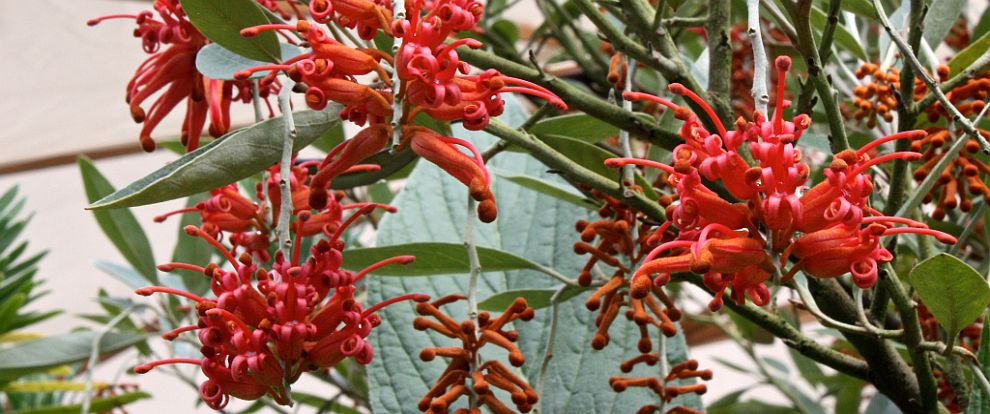
The photograph at the top of this page shows Grevillea victoriae, the royal grevillea, which is endemic to Australia’s Victoria state. It was first described by botanist Ferdinand von Mueller in 1855 and was duly named after Australia’s Empress of the day, Queen Victoria.
Past Events
March 2026 - Elsternwick
Rippon Lea Estate visit: “As Beautiful as a Dream”
Rippon Lea is one of the few remaining examples of the many “palaces of the rich” which impressed Mark Twain when he visited Melbourne at the end of the nineteenth century. Only nine kilometres from the city centre the grounds are still “ducally spacious” and “as beautiful as a dream”. Preserved by the National Trust, they speak of an opulent era in other parts of Australia, but nowhere could quite match Melbourne.

The mature garden today has a tapestry of deciduous and evergreen trees, including oaks, elms, conifers, native figs and palms. Other components are sweeping lawns, an ornamental lake, and a gigantic fernery. Although this may not sound very Mediterranean, our Victoria branch of the MGS was fascinated by our tour, particularly the understoreys of very tough plants which can endure our long dry summers. These included various Ruscus species, clivias, bromeliads, echiums, buddlejas …

We were especially lucky too that we had our guided tour with Darren Ball, the Head Gardener, who is a long-standing member of the MGS. He worked at Sparoza back in 2016 with Sally Razelou and is a regular visitor to Greece. He described the very careful use of water and the various attributes of the many plants we encountered.

After a fascinating introduction from Darren at the gatehouse, our group of some seventeen members began our walk up the long winding drive.

Our access was barred from some areas as the large cones from the bunya bunya pines (Araucaria bidwillii) were falling and could have a fatal impact.


Although it was a hot morning, we all lasted the course and the rain finally arrived that evening. A reason for rejoicing after our long dry summer. I photographed my Drimia maritima this morning, reaching its peak, as the sea squills at Rippon Lea had already finished flowering: a lovely reminder of our fascinating visit.

Photos and text by Caroline Davies
September 2025 - Warramate Hills
Meg Bentley’s Salvia Gardens, Gruyere via Seville

Meg Bentley was a generous host again, offering unusual salvias for sale at reasonable prices and providing morning tea deep in the garden. She has amassed a beautiful collection of plants, spread across her rambling hideaway of a couple of acres, deep in the Warramate Hills.
We enjoyed a convivial lunch at Killara Estate winery.
Although we didn’t get there on the day, a visit to the Salvia Study Group Garden at the Nobelius Heritage Park, Emerald, a public garden and so could be included on any day out in the Dandenongs.
December 2023 - Geelong
Succulents Galore and much more - Our last branch outing for 2023
A simply beautiful array of tough plants welcomed us to Roraima, Lara, on the outskirts of Geelong - the inspirational display garden and nursery of Lyle Filippe. This was the last garden event for the Victoria branch in 2023 and Malcom and Fran Faul gave us a wonderful experience as always. Not only does Roraima have a diverse and unusual range of plants for sale, but the way they grow in the various, ever-expanding display gardens is inspirational, combining textural contrasts, shapes and hues.

If I had the space I would love to grow all these different plants in the one huge container. As it was, a number of us did buy unusual plants to brighten up spots in our own gardens.

Earlier in the morning we had visited Sue Davis at Suealoe, at nearby Lovely Banks and she was growing a huge range of succulents and cacti set in her native woodlands. Although so many aloes flower in winter here, we were thrilled to see a number in bloom in summer.

More plant acquisitions took place here including this brilliant Aeonium “Sunburst”, which will brighten up a spot in my garden when so many plants are in summer dormancy.

Over lunch afterwards we talked about our wonderful day and what 2024 will hold for us. Warmest thanks to Malcom and Fran for steering us through another year.
Text and photos (unless stated otherwise) by Caroline Davies
October 2023 - Riddells Creek
Visit to Eremophila Park
Something we are often thinking about at the Victoria branch of the MGS is the use of hardy, drought-tolerant Australian native plants in our gardens. Thanks to the detective work of Malcolm and Fran Faul, we visited the extraordinary Eremophila Park at Riddells Creek in October where we were shown around by owner Russell Wait. It’s not surprising he was drawn to this genus, the name “eremophila” meaning desert lover, and Russell spent much of his life in the dry Mallee region of Victoria before coming to Riddells Creek eleven years ago.

Eremophila waitii, known as Silky Lavender, was named after Russell and is a tribute to all the plant-collecting and observation he has done in the wild, predominantly in Western Australia.

This variety flowers profusely earlier in the spring, but Russell was able to find us an example of its distinctive flower.

Another variety we admired was Eremophila caerulea which is a lower-growing shrub and was flowering abundantly for us.

Russell also grows many other Australian native plants including Hymenosporum flavum (native frangipani) which was reaching for the sky above banks of tough shrubs.

Of interest to our group, some of whom belong to the C.J. La Trobe Society, was Eremophila latrobei, which was first described in 1859 by Government Botanist and Director of the Royal Botanic Gardens Melbourne, Ferdinand von Mueller, and named after Charles Joseph La Trobe, the first governor of Victoria in 1851 when the state was proclaimed in its own right, no longer subservient to New South Wales. The flowers were virtually over but we saw what a vivid red they are and why its common name is crimson turkey bush.

Russell has covered over 400,000 kilometres on his botanical trips and grows over 200 varieties of Eremophila in his garden. These are displayed in raised beds defined by local rocks, and he has brought in the additional soil (clay) which is topped with scoria. He is emphatic that none of these plants are watered. His wealth of knowledge is displayed in the impressive book, “Growing Eremophila” which he wrote in conjunction with Christine Huf, Cathy Powers and Jenny West, published in 2021. With all our questions the very informative tour took some two hours and the unanimous verdict was these plants should be grown more in Melbourne/Victoria gardens with the way our climate is going. Several people left with a plant purchased from Russell’s nursery and others with his book.

Text and photos by Caroline Davies
November 2022 - Kinglake
Visit to Antique Perennials
Today’s excursion was our last for 2022 and we were experimenting with a Monday outing which was enthusiastically supported, many of us having weekend commitments. Our visit was to the picturesque Kinglake area in the Yarra Valley, some 56km north-east of Melbourne. Our destination was Antique Perennials, one of Australia’s leading growers of rare, unusual and hard-to-find perennials (and bulbs), at a time when there is little diversity of plants at general nurseries. The display gardens were enlightening showing the way perennials and grasses can be used in the Australian context.

Our guide, Matt Reed, co-owner of the wholesale nursery, gave us fascinating information. For example, we learnt that the lady’s mantle in the gravel was not Alchemilla mollis but another type called Alchemilla xanthochlora. The former lady’s mantle is very difficult to grow in Victoria, but the second is much tougher in our conditions. Plants were established in the Australian Alps in the early period of European settlement and it is often considered to be an Australian native, but this has yet to be proved. It has similar looking lime-green flowers, and the scallop-edged leaves also collect raindrops in the most endearing way.

We admired the white lamb’s ears (Stachys discolor) with its spikes of larger white flowers along with crinkly leaves. A plant which was also drought resistant.

Most of the display garden was only watered four times last year but the mediterranean border was only watered once. Here is a compact, particularly blue form of Melianthus major along with more Kniphofia varieties.

We all acquired plants, including the special lady’s mantle, and adjourned to the Kinglake Pub for continued discussion, an update which I gave on the recent Athens AGM, and plans for our Victoria 2023 programme. Warm thanks as always to Malcolm and Fran Faul for making it all possible.
Text and photos by Caroline Davies
October 2022 - Surf Coast
Visit to gardens in Anglesea
Spring started for the branch with a simply beautiful day weatherwise to Anglesea on the surf coast of Victoria. We started the day with an introduction to the local vegetation in the extensive garden which surrounds the Anglesea Primary School. Our guide was Bill Mackellar, the leader of the community group which established this impressive landscape. We also returned here for our picnic lunch in the shade of tall trees in a bushland setting. We visited four private gardens in the vicinity all inspiring in their different ways. Here some of us are looking very rested and happy in the garden of Bill and Olivia Clarke. The tall eucalypt is a manna gum (Eucalyptus viminalis) and far left in the group is Malcolm Faul, Branch Head, who organised the day with his wife Fran. More about this garden later:

Our first private garden was a lovely mixture of plants with a great over-view from a terrace above the garden. Many admired the Geranium maderense – both mauve and white flowering, with their attractive incised palmate leaves. The garden owner, Jocelyn Cox, had seen these plants flourishing in gardens on the Portuguese island of Madeira which she visited in 2009, not long before she moved to this spot. An interesting footnote to this was that during our discussions about the geranium, it emerged that one of our MGS members on this trip had been the first person to import it into Australia some years ago when he had his nursery.

Aloes were aglow with their brilliantly coloured flowers – this one was Aloe ferox, managing well despite the shade from the pear trees.

A Mediterranean stalwart is Convolvulus cneorum, native to coastal areas of Spain, Italy, Albania and Croatia … This one was smothered in flowers unlike the Cistus salvifolius behind it which was only just starting to flower.

There were pots scattered around the garden and this collection on the terrace, overlooking the Cistus salvifolius were eye-catching.

A pure white form of the Australian native orchid Dendrobium kingianum was flowering its heart out in the filtered light from the tree canopies.

In our next garden, up a steep hill, was this pink form of Dendrobium kingianum nestled in the silver foliage of an olive tree.

There were many more aloes: this fan aloe was backed by a tapestry of contrasting foliages. Formerly Aloe plicatilis it has been reclassified as Kumara plicatilis.

Extending the aloe theme: a fan aloe was backed by a tapestry of contrasting foliages. Formerly Aloe plicatilis it has been reclassified as Kumara plicatilis. Extending the aloe theme was this climbing form, now Aloiampelos ciliaris, scrambling through the massed succulents and right up the tree trunk.
Back to the Clarke garden and a photograph taken by Olivia from the house, looking down on many of us assembled on the grassy area, loved by their grandchildren, and surrounded by the native vegetation which was filled with native birds. The garden descended behind us with a dry creek bed and water features which used recirculated water.

It was lovely to hear the soft sounds of the moving water as we wandered further.

In the shade of the house was this magnificent bird’s nest fern (Asplenium nidus) which needed the partial shade but is an incredibly tough Australian plant.

We were very lucky to see the Tawny Frogmouth and its baby although brilliantly camouflaged in the tree. This native bird, often mistaken for an owl, was one of many birds in the garden, attracted by the native vegetation, and the Clarkes were keeping a record of all their visitors. Bill had taken this photo in the morning when the birds were not overcome by so many of us.

Our last garden was Ironbark House, Jan Juc, and on a very large scale. The driveway is bordered by a grove of black-trunked ironbark trees (Eucalyptus tricarpa) hence the property’s name. Of note around the house were the skilful plant combinations and contrasts. Such as the black aeoniums and golden heads of euphorbias.

Much interest was shown for this “Chocolate Mint” Pelargonium, a hybrid of Pelargonium tomentosum nestling in yet more euphorbias.

And big sweeps of colour came from the various geums which edged the lawn by the house.

This native hibiscus, Alogyne huegelii, one of quite a few we saw through the day, was simply covered in blooms, heralding the many native plants to be seen in a newer area of the garden descending a slope to the labyrinth.

With minds filled to overflowing with ideas for our own gardens, we ended our Anglesea day and with warm thanks to Malcolm and Fran Faul for organising it all.
Text and photos by Caroline Davies (apart from where otherwise indicated).
March 2022
Visit to the Melton Botanic Garden
We have started 2022 on a positive note with a visit to the Melton Botanic Garden which features plants well-equipped to cope with the arid landscape in this western part of Melbourne. Our guide, John Bentley, who leads the very active Friends group, gave us an inspiring guided walk, beginning in the Mediterranean Garden which was established from 2017 onwards. Plants receive minimal water and there are some seven varieties of oak, highlighting the diversity of this genus.

We started with Quercus canariensis, the Algerian oak, found throughout the Mediterranean region, forming a wide canopy, making it a good alternative in our changing climate to the English oak. This tree was planted in 2017 and is growing steadily but slowly with its limited water.

Another striking and equally hardy oak, planted at a similar time, was Quercus alnifolia, the golden oak of Cyprus. Its common name refers to the distinctive golden-coloured undersides to its leaves which are a glossy green on their surface.

The Irish strawberry tree (Arbutus unedo) another Mediterranean mainstay was showing its flower-buds and had a lovely backdrop of eucalypts and other Australian native plants which form the natural setting of these gardens and predominate many of the different sections.

It was a relaxing interlude to stop and sit by the lake fringed with magnificent and contorted river red gums (Eucalyptus camaldulensis) and native grasslands typical of this region.

We moved on to the Western Australian and South Australian gardens where our guide John was a source of knowledge. Many of the more unusual plants were labelled and some of the hard landscaping with rocks and boulders had been done by “work for the dole” groups.

Our eyes were drawn by this bright-red painted tree trunk complementing the flowering aloe spikes in the Aloe and Succulent Garden.

Another brilliant vision of colour was from the Plumbago auriculata ‘Royal Cape’ in the nearby South African garden.

Many questions were asked about this distinctive cabbage tree (Cussonia paniculata) an increasingly popular South African tree in Australian gardens. Our final treat was a special opening of the Friends’ nursery at the end of our walk, beautifully laid-out, and many of us took advantage of the array of unusual plants to leave with a pot or two.

We adjourned to the historic Eynesbury Estate with its fine bluestone homestead built in 1875 for pioneer pastoralist Simon Staughton. The long drive towards the house was inspiring through extensive grey box forest (Eucalyptus microcarpa), one of Victoria’s largest stands of this eucalypt and forming a natural buffer for Eynesbury from the ever-expanding city of Melton. Over coffee and lunch in the bluestone stables, we talked about the plants we had seen and optimistic garden plans for the future.
Text and photos by Caroline Davies
December 2021
A visit to two gardens east of Melbourne
We were able to end the year on a high note with Covid lockdowns over and visits to two inspiring gardens created by their talented owners with many interesting ideas for city and country gardening with our changing climate.
Our first destination was Woodcote, the home of well-known landscape designer, Sandra McMahon, who with her late husband, architect Warwick Sheffield, purchased the half-acre property in 2008 and set about creating a garden to complement the atmospheric “Arts and Crafts Revival” house designed by Warwick.
Sandra gave us a warm welcome and explanation of her gardening philosophy as we mingled in her front garden which is reminiscent of the Victorian high country and is never watered. Of particular charm was the contrast between the different garden rooms at Woodcote which make up her design.

A striking feature was the copse of Australian snow gums (Eucalyptus pauciflora ‘Edna Walling Little Snowman’) – an excellent choice for Melbourne gardens with its smaller form and attractive weeping habit.

A joy was to see the trigger plants (Stylidium gramnifolium) scattered through the front garden, reminding some of us of past high country summer holidays.

A beautiful blend of yellows, kangaroo paws (Anigozanthos sp) and native paper daisies were accompanied by native grasses and contributed to the relaxed atmosphere.

The star-shaped flowers of Isotoma axillaris, a small herbaceous perennial,made a vivid and dainty ground cover.

The route to the back garden followed a pebble stream in a Japanese style garden room, leading out beneath a massive elm – a huge horticultural challenge and another garden room different in character – a tapestry of foliages leading on to an orchard, rose garden (featuring many rugosas) and a great use of grasses and perennials.

Our next destination was the country garden of Virginia Heywood and there were many plant distractions, including these splendid Californian tree poppies (Romneya coulteri)as we walked to celebratory drinks (a toast to 21 years of the MGS in Victoria) behind the house.

As well as the magnificent country views, this garden was packed with unusual plants including a delightful single pink rose, Rosa x Nieuwesteeg, from famous rosarian John Nieuwesteeg and believed to be a cross between Rosa foliosa and R. wilmottiae.

We admired many hardy plants including these Berschorneria yuccoides, often confused with yuccas and hailing from Mexico.

The dogwood was beguiling although it would not prosper in central Melbourne.
And over a leisurely picnic lunch we were joined by an Australian king parrot, ever hopeful for crumbs. The garden was filled with Australian native birds.
Text and photos by Caroline Davies
March 2021
2nd Pan-Australian Conference of the MGS - Castlemaine
The leadup to the rescheduled Castlemaine conference, with a snap 5-day lockdown in Victoria and just a month to go, was a reflection of uncertain times during a global pandemic. A sense of jubilation prevailed as members gathered at the Midland Hotel for the welcome drinks on Friday 12 March, a year after the original date. Since then, venues had dropped off and garden owners cancelled, while others generously made their gardens available. Inevitably members’ ability to attend changed too, but final numbers were significant: the interstate attendees were a courageous lot, risking border closures and the possibility of quarantine, all for the love of mediterranean gardening … Those who took the gamble to swell the large number from Victoria included seventeen from South Australia, two from New South Wales and one from Queensland.
The lecture programme, true to the original plan, was introduced by Malcolm Faul, branch head, who explained how the caper Capparis spinosa, provided the perfect context for the conference. “Castlemaine Capers” was the ideal epithet. Videos of three of the lectures are provided below with a common theme of a planting palette and garden design determined by scarcity of water and topsoil, hot dry summers, and cold frosty winters.
After a very wet start and lunch at historic Buda, followed by a walk through the Castlemaine Botanic Gardens for the valiant few, the sun shone for the remainder of days. A splendid start saw us visit Lixouri at Barkers Creek along with Hedgehogs next door. Both are owned by keen MGS members, Margaret Beyer and Margot Rottem respectively. And we were treated to a host of interesting plant combinations, mediterranean landscaping, lots of Australian native plants and hands-on involvement and information from our hosts and their husbands.

Lixouri is named after a village on the Ionian Island of Cephalonia where the owners spent some eight happy months many years ago before they built their mudbrick house and created their garden in this very tough environment.

We saw more sedums than could be imagined on our travels, including wonderful displays of Sedum “Autumn Joy” – now Hylotelephium spectabile “Autumn Joy” such as this expanse at Forest Hall, Castlemaine.

A highlight was our visit to Dr Peter May’s garden at Kyneton where he showed he practises what he preaches – refer to the lecture link below and also the excellent article by Megan Backhouse in Melbourne’s “The Age” newspaper. A star in his garden was Calamagrostis x acutiflora “Karl Foerster”, the tall imposing grasses towards the rear of the photo.

Sternbergia lutea was another prominent bulb displayed at our destinations and a reminder of autumns in Greece.

Colchichums, including this huge hybrid: Colchichum giganteum ‘’Giant” were prevalent especially at the “quarry garden” at Stone Hill, designed by Michael McCoy, another of our lecturers.

We even visited a garden called “Sedum”. On a very steep site at Hepburn Springs , it was created with a bushfire safety perspective. The owners have lived in this fire-prone district for many years and experienced the Black Saturday Fires of 2009. They have utilised succulents, herbs and bulbs which have low flammability and with a charming effect.

Nearby Lavandula boasts fields of lavender, sprawling gardens and old 1850s buildings such as this pointing to a local Swiss-Italian heritage in the rolling hills of Shepherd’s Flat.

Many plants familiar to those who have visited Greece were in evidence at the “Mediterranean Garden” at Lambley Nursery, Ascot including this splendid chaste tree, Vitex agnus castus.

And beautiful borders and vistas ended our final inspiring day, again at Lambley Nursery.
Text: Lindy Neylan and Caroline Davies, photos Caroline Davies
Day One Lecture programme
Despite postponement from 2020 due to Covid, this was a most successful conference, attended by MGS members from across Australia. Here are video recordings of some of the talks given on the first morning of the programme.
David Glenn is founder and proprietor of Lambley nursery and display gardens. He has been a nurseryman for 55 years is the leading supplier of Mediterranean plants in Victoria. The garden is on the inland plain of Victoria at 450m and can experience temperatures from -6 to + 45C. Both nursery and garden are internationally recognised. In his talk “Turkish trees, shrubs, perennials and bulbs in the garden at Lambley”, David introduces us to some of the marvellous plants from Turkey which grow happily at Lambley with photographs taken in the garden.
Peter May is former head of campus, University of Melbourne, Burnley Campus. Burnley is the leading horticultural education and research institution in Victoria. In his presentation “Some thoughts on gardening in a Mediterranean climate”, Peter looks at the way climate tools may be of use in making plant choices for gardens in places with dry summers. He also makes some observations about soil influences on planting success and discuss some of the techniques that can be used to modify soil properties, with some emphasis on contemporary methods with references to his own, relatively young garden.
Caroline Davies is President of the MGS. In her talk “Wild flowers and gardens of Greece and the Mediterranean” she illustrates the beauty of the natural landscape with its intensity of light and wealth of wildflowers in spring and autumn, tying this in with the approach by many mediterranean gardeners in Greece and other countries to create gardens of great beauty, whilst gardening in a sustainable way, allowing Nature to show the way. In her tiny garden too, she replicates visions of the plants admired on her travels.
November 2018
Gardens of Stonnington
Our special day of smaller gardens in Toorak and Malvern was extraordinarily successful, in perfect weather with spring flowerings at their best. Our heartfelt thanks go to the owners and to Caroline Davies as the organiser.
We began at the Toorak garden of Fiona Brockhoff. Her garden features her creative ideas for gardening where space is limited and with ways to cope with difficult conditions. Here the borrowed landscape is integrated into the overall design of the garden and plants have been carefully chosen to best suit the various micro climates in the garden. The roof garden in particular made good use of the borrowed landscape. The price paid for the borrowed landscape is fearsome root competition: plants were chosen with this in mind.
This was followed by Caroline Davies’ exceptional collection of pots of unusual plants, married with interesting sculptures and artefacts. It never ceases to delight.


Susie Brookes delightful garden makes significant use of pebbles as a mulch on the elevated rear terrace, with a large area of Nierembergia rivularisas ground cover. Amongst the many highlights, the avenue of Tilia cordata along the side fence and the dramatic creeper against the house. Even the lunch at the Seasonal Kitchen seemed to have a garden feel, outside under a huge neighbouring Moreton Bay Fig.
The fourth garden was of the late Marian Brookes, a notable plants woman. Margie Brookes has maintained the garden for many years and continued to do so up to our visit, although the house has now been sold. We were privileged to have her as our host for the visit. Hardier plants populated the front garden under a large tree. However, the back garden was a riot of colour over a surprisingly large area, with hidden beds in each of the back corners. The view from the patio was enhanced by its elevated position.

April 2018
A guided garden tour to Lambley Gardens and a visit to Frogmore Garden and Nursery
Despite persistent drizzle, everybody enjoyed David Glenn’s guided tour of Lambley Gardens and his own garden around the house. David, who is gregarious, was extremely generous with his time and loved telling us about the plants and how he managed to introduce some of them to Australia. Since we last visited as part of the MGS AGM in 2012, what was then the propagating area has become the main show garden, with many floriferous borders (despite the autumn season and the long dry period) and sculptures and other garden ornaments as focal points. David steered us clear of the area that had previously been the main garden and showroom for desirable dry-climate plants. This area is undergoing a major renovation. We sneaked in after the tour and observed the true survivors of the summer.

After a pleasant drive through Daylesford along attractive roads through picturesque villages we arrived at Frogmore Garden and Nursery, Blackwood. The owner gave us a brief presentation (and umbrellas), after which we were free to roam the extensive garden, which has many fine, long and wide borders. Under his tenure he has dug many truck-loads of compost into the clay soil and also added gypsum.
While this is not a drought-tolerant garden, the owner explained that he nevertheless uses only a fraction of his water rights (as does Lambley). The garden features a very wide range of unusual plants, and grasses are used to great effect. The exotic trees were colouring beautifully. They are maturing well, having been planted 17 years ago when the garden was established. Their autumn colours looked stunning against the surrounding mist-covered grey-green forest. If you missed this garden visit, go when it is next open in March and April next year (check the website) – the nursery is open all year.

For older reports and articles please check out the archived (non-responsive) Victoria Branch page.
Background on Branch Head Malcom Faul
Malcolm is a retired accountant with an interest in gardens and gardening, inspired by his wife, Fran and her knowledge of and interest in plants, landscape design and history. They are long-standing members of the MGS. They are also active members of the Australian Garden History Society.

Fran and Malcolm organise and take part in a working bees programme on historic gardens that cannot have the labour to maintain them in anything like the style of when they were created 100 years ago.
THE MEDITERRANEAN GARDEN is the registered trademark of The Mediterranean Garden Society in the European Union, Australia, and the United States of America