
Mediterranean Garden Society
Mediterranean Garden Society
The Italian Branch of the MGS
In Italy the members of the MGS reside in all the Regions and therefore have very different gardens and types of planting, but we try to manage our gardens in an eco-sustainable way, especially with low water consumption. We offer an annual program of visits and meetings for members to:
Our Branch Head is Angela Durnford (Biography). Please contact Angela to find out more.
Click here for a series of walks in the Sibillini Mountains (in English) where we accompany MGS member Jan Thompson on her hunt for wild flowers.
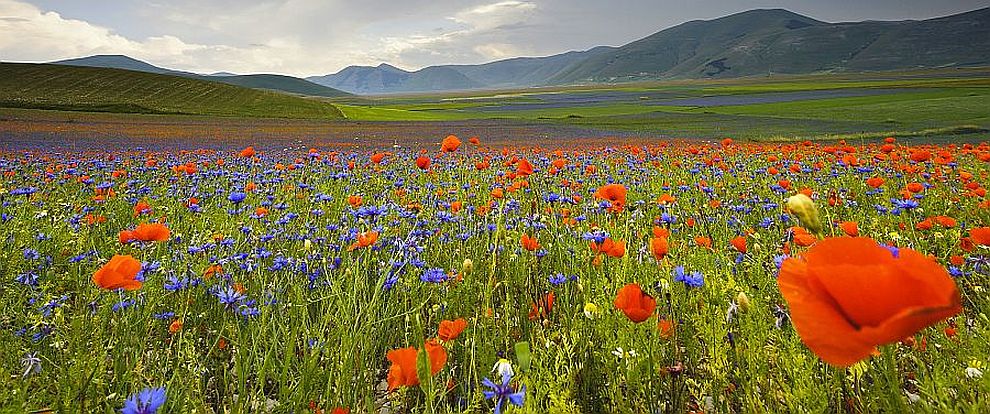
The photo at the top of this page shows the Piano Grande in Umbria, a large plateau full of wild flowers surrounded by the vast amphitheatre of the Sibillini mountains at 1,500 meters above sea level. In June we see the so-called 'infiorata': meadows splashed with the colors of the crops, including the famous lentils of Castelluccio. The fields bloomed even in 2017 after a devastating earthquake which destroyed Castellucio and blocked the roads leading up to the plateau.


Past Events
November 2025
Gundula Deutschländer, Master Gardener, South Africa
“Babylonstoren, a Collection of Garden Stories”
Gundula Deutschländer has been nurtured by her family of plants, men and women from both sides of the Atlantic Ocean. After finishing a Fine Arts degree at Stellenbosch University, she travelled widely in the appreciation of untamed nature and iconic gardens. Her travels from Island to Iran and various parts of Africa have influenced her garden designs and the cultural dialogue with nature. She has worked in the gardens of John Ruskin at Brantwood, in the Lake District in Britain. For some years she worked at a private garden in Greece where she had the privilege of regularly visiting Sally Razalou at Sparoza. On returning to South Africa she landscaped various private gardens and parks before settling at Babylonstoren 17 years ago to initiate the garden there.
With the Simonsberg, Du Toitskloof and Franschhoek mountains as backdrop, Babylonstoren in the Drakenstein Valley of South Africa sits at the heart of the Cape Winelands. The restored Cape Dutch farm dates back to 1692. It’s renowned for its magnificent 3,5 hectares garden with pergolas, gravel pathways and water canals. The design was inspired by the historic Company’s Garden in Cape Town, which for centuries supplied ships sailing between Europe and Asia with vegetables and fruit. It also makes a playful nod to the mythological Hanging Gardens of Babylon. In 2007, owner Karen Roos commissioned French garden architect Patrice Taravella to plan the layout. The garden divides into 15 sections that include vegetable patches, orchards of fruit, nuts, fragrant indigenous plants, ducks and chickens, bees for pollinating and a palette of trees of historical or botanical significance. Gundula’s talk describes the creation of the garden: how it started with a cutting of Newton's apple tree and ended up with a collection of native plants housed on a rock piano similar to those used by South Africa’s indigenous people centuries ago. Babylonstoren is a garden with a Mediterranean climate growing food for thought, food for the soul and some food to snack on while exploring on foot.
October 2025 - Liguria
Visit to a specialist vivaio and a private garden
Members of MGS in Liguria enjoyed a visit to a specialist plant nursery and private garden in the province of Imperia.
First stop was at Vivaio Ciancavare near to Pontedassio where we were welcomed by owners Clemence and Daniele. The nursery is at about 500m above sea-level and set in a small amphitheatre with wonderful views over the surrounding hills. Clemence and Daniele have been collecting, propagating and researching Mediterranean flora for about 20 years.

There is a demonstration garden showcasing a large number of species, with the aim of creating a biodiverse community. It is tended with ecological principles in mind and plants are not watered once they have established. Although our visit was in October, following the usual dry summer, the garden remained interesting and attractive. A wide range of Artemisia, Euphorbia, Helichrysum and Santolina are grown together with Cistus, Rosmarinus, Teucrium and Phlomis and a number of lesser-known drought tolerant plants.

A new innovation is experimentation with raising plants in sand beds (as advocated by Peter Korn who has given a video presentation to MGS). They also aim to see if plants propagated and raised on sand can then be transplanted successfully into garden soil as well as grown in sand. Several members subsequently put in orders of plants for delivery. Visitors are welcome by appointment and Clemence and Daniele are always happy to discuss and advise on projects and plant requirements and there are descriptions and advice on cultivation of the plants on their web-sites.
Following a brief pause for a sandwich at San Lorenzo al Mare, the group headed on to visit the wonderful private garden of Dina Barla at Cipressa.

The garden is set in a stunning location overlooking the sea. Dina started the garden a decade or two ago as she is a very talented flower-arranger and she wanted to have lots of different flowers and foliage to use in her displays. However, she clearly has a real love of the garden and talked with real passion and expertise about the plants within it.


There is a large variety of well-established and unusual plants, into which a number of ‘found’ objects have been inserted – all painted azure blue to match the sea. This was surprisingly effective at providing a cohesion to the garden.

As well as displays of a range of succulents at various locations there are places to sit and admire the garden from different perspectives, although Dina freely admitted she doesn’t get the chance to sit very often!
October 2025
Attila Kapitany, Plantsman, Expert Cacti and Succulent Grower, Author, Australia
“The Future of Succulents in Cultivation”
Attila Kapitany is well known for his passion for cacti and succulents, especially those that are native to Australia. He was president of the Cactus & Succulent Society of Australia for 10 years. Attila has over forty years’ experience growing and enthusiastically marketing succulents. Attila is also a member of the Horticultural Media in Australia, Australian plant Society writing regularly in magazines, journals and newspapers and promoting mostly native succulent plants. He has co-written seven books with Rudolf Schulz about succulents, with an eighth book a solo effort on Australian native species. His newest publications are a series of twelve booklets on xerophytic Australian plants. Attila regularly tours the Australian and international speaking circuits also featuring on television and radio.
In his talk to members he addresses what the future might hold for succulent popularity as climate change opens up new planting possibilities for gardeners. He also examines exciting, interesting and unusual cacti and succulents in modern and future garden design and showcase his own one acre landscaped garden created with his wife Michele over 22 years. Here Australian native succulents as well as bottle trees and other Australian dry climate plants are mixed in unusual and visually striking combinations.
September 2025 - Lazio
Visit to the gardens of Villa Medici, Rome

Our inaugural meeting for the MGS Italy group in Lazio.
The gardens are being restored to their original 17th century design and the maintenance of the park is being done in an ecological way, improving the soil, saving on water, restoring the sacred forest, and re-establishing the agrumi collection. It’s a radical idea and a very contemporary approach to gardening, all combined with historic conservation.
Our guides were Gerardo Fernandez Medina, Head gardener and dottore agronomo, Francoise Laurent, Landscape architect.

Were we especially interested to learn how more sustainable techniques were being introduced to the gardens, which were immaculate despite there being only six gardeners to tend all 7 hectares.

Where the formal hedges were being restored, they employ a mixture of four different plants to enhance disease resistance - box, bay laurel, phillyrea and lentisk - which still gives the impression of a deep green dense wall of foliage.

We were treated to a private view inside the Pavilion of the Birds and toured the ‘Bosco’ woodland area on a hillock behind the Villa.

Everywhere there were breath-taking views across Rome and historic sculpture.

And then to lunch at the top of the Spanish steps. What a glorious day!

September 2025
Dan Hinkley - Plantsman, Author, Lecturer, Nurseryman and Horticultural consultant, USA
“A “Pseudo” Mediterranean Garden in the Pacific Northwest”
Daniel Hinkley earned a B.S. in Horticulture and Horticulture Education from Michigan State University and an M.S. in Urban Horticulture at the University of Washington. For forty years, Daniel has travelled the globe to similar climates to observe and preserve plants that deserve recognition as possible new additions to landscapes worldwide. He has written four books and has been recognized by his peers in receiving numerous awards for his work, including the Liberty Hyde Bailey award from the American Horticulture Society, the Scott Gold Medal from the Scott Arboretum and the Veitch Memorial Medal from the Royal Horticultural Society.
His first garden, Heronswood, near Kingston in Washington State is now owned and operated by the Port Gamble S'klallam Tribe and is opened to the public throughout the year. His current garden, Windcliff, is situated just a few miles from Heronswood and sits on a high south facing bluff overlooking the Salish Sea in the Puget Sound. It comprises 2.5 hectares (6.5 acres) and enjoys less than 75cm (30”) of precipitation per year and no measurable rain during June-October. Daniel's method and style of garden has been adjusted to include plants requiring little supplemental water. He will take participants on a visual tour of the garden, highlighting those plants from around the globe requiring less water though delivering enormous visual effects.
June 2025 - Umbria
Paciano Infiorata di Corpus Domini
MGS Umbria-Marche group members took part in a unique village event in Paciano (PG) to witness and take part in the festival Infiorata di Corpus Domini.

The word "infiorata" literally means "decorated with flowers" and this is exactly how the street paintings created for the occasion are made, using flower petals, earth, and sometimes even beans or wood cuttings. In Paciano the infiorata has been happening for centuries, with the modern incarnation, “Il Gruppo Infioratori Paciano”, forming 60 years ago.

First flowers must be ordered or collected and transformed the day before the religious procession into boxes and boxes of brightly coloured petals or buds. In the evening several sub-groups of “infioratori” lay out their designs with chalk and begin to fill them in with the collected materials.

This year a rainstorm early on Sunday morning had washed away some of those designs while others were saved with tents.

Nevertheless the community showed up in force, improvised new designs and worked like crazy in order to be finished by midday.


MGS members were able to join in with the work and it was amazingly uplifting to spread just a few flowers on the street with each other and to see the whole Paciano community pulling together despite inclement weather challenges.


After watching the procession we joined all the infioratori for a celebration lunch.

Text: Angela Durnford
Photos: Sergio Ungaro
June 2025
Umberto Pasti, Writer and Gardener, Italy / Morocco
"Rohuna: A Written Garden.”
Umberto Pasti divides his time between Italy and Morocco. After graduating in Philosophy of History, he started his career writing about art, literature and society for the Italian press. He has created gardens in Italy, Spain and Morocco though he prefers the title gardener to garden designer. He has made the nature of North Africa the protagonist of many of his books translated mostly into French, Spanish and Moroccan Arabic: L'età Fiorita (2000); L’Accademia del Dottor Pastiche (2008); Giardini e No (2010); Più Felice del Mondo (2011) and Animali e No (2016). He has written two books about Rohuna: Perduto in Paradiso (2018) and Un Giardino Atlantico (2019) - the latter was translated into English as Eden Revisited. His latest titles are The House of a Lifetime: A Collector’s Journey in Tangier (2023) and Arabesco (2024).
Driven by his passion for the wild flora of Tangier and its surrounding region, over the past two decades Umberto, together with his team of local gardeners, has transplanted greenery (over 5300 species of plants, flowers, and trees) salvaged from all over northern Morocco to this stony hillside at the edge of remote village fifty kilometers south of Tangier. When it started the initiative seemed almost quixotic – there was no access to water or electricity - but it has led to the creation of a garden that now attracts visitors from all over the world.
The garden is a romantic and untamed paradise inspired by the traditions of English and French gardens of the 1930s: the Garden of Consolation, planted between two small houses, is formed by a series of rooms and terraces with lush vegetation and surrounding it is the Wild Garden and a hillside devoted to wild flowering bulbs.
However, Rohuna is not just a garden with a mission to preserve the botanical richness of the region. Its creation has radically improved daily life in the village by funding the restoration of the school, by employing workers from the village and by providing educational opportunities for the youth. Umberto talks about his Rohuna adventure - showing how a dream, pursued with determination and a willingness to face challenges - can transform the life of both the land and a small community.
June 2025 - Liguria
Visit to Parco Durazzo Pallavicini Genova
The Liguria Group Spring Event took place at Parco Durazzo Pallavicini, Genova. The park was created in 1840 by Michele Canzio, a genovese architect, decorator and theatrical set designer. It is designed as a theatrical event and divided into a number of spaces (described as Acts and Scenes) in which the planting and structures create different atmospheres. For example, an avenue of square-shaped topiary of laurel and box and lined with large white vases ends at a triumphal arch. After walking through the arch the landscape changes to a narrower path running along the side of a mountain that is planted with hollies, firs, yews and ferns and containing a small rustic building made of wood.
There are several water features within the garden including a natural-looking lake where the planting is somewhat wild, evoking nature, and a small basin into which water flows from the side of the mountain, overlooked by a wooden hut with thatched roof.

Towards the end of the walk around the park the visitor walks through an extensive grotto - a series of artificial caves which have been coated with natural stalactites and stalagmites that have been transported from nature caves around Liguria. The route then opens up onto a large open lake surrounded by a range of follies including the Temple of Diana and a Pagoda and Chinese Bridge.


One of the final scenes is the garden of Flora containing more colourful planting, much of it in pots, in comparison to the green that predominates in the rest of the park.

The planting throughout is lush and verdant and this is unlikely to be a ‘water-wise’ garden. There were also few plants that one could describe as Mediterranean species. However, this would reflect the prevailing fashion at the time in which the park was created of English romanticism. There also appears to be as much attention paid to landscaping and structures than to plants.

After the visit members adjourned to a nearby restaurant to enjoy a seafood lunch!
May 2025 - Tuscany
Designer Gardens in Chianti
Members enjoyed a happy and horticulturally most interesting two day trip into Chianti in Tuscany in late May. The gardens we visited, chosen by Carol Smith and Yvonne Barton of the Italian branch of the MGS, were the work of well known professional landscape and garden designers and had much in common with one another while also being each quite distinct in style and outcome.

Our first visit was to the relaxed yet formal garden at Tenuta Perano designed by the English designer Richard Shelbourne on the roof of the vast Frescobaldi underground wine cantina, a veritable cathedral of wine.

With only 40cm of soil between roof and sky, opportunities might appear limited for a garden, but his formal planting with box-edged circular and semi circular beds, contrasting with white Iceberg roses was welcoming and delightful, making the most of the views of the Chianti hills which we enjoyed from the elegant conservatory restaurant.

A delightful pergola of wisteria and roses, edged with catmint led the eye and created movement through the garden. We enjoyed a most lively and convivial lunch accompanied of course with wine from the Frescobaldi vineyards and a tour of the wine cellars.

A drive across white roads through the majestic Chianti countryside brought us to La Petraia, where the head gardener Will Smithson has been making his mark on the framework in collaboration with the designer Arne Maynard since 2020. Apparently in the middle of nowhere, with breathtaking views, the upper terraces have little depth of soil due to a challenging elevation at 700 metres. Despite this and an abundance of greedy wildlife, this jewel of planning and faultless execution caught and held the attention of all. English in style, with a relaxed and yet formal structure, nature was allowed to do its thing under a careful and expert guiding hand.

Effective combinations of plants of different heights largely in soft pastel or silvery hues reappeared repeatedly throughout the garden. Recent tree planting has been made to coexist with the established environment by deliberately introducing less than “perfect” specimens such as the delightful pollarded plane (Platanus orientalis) arbour shading a dining area.

Will had interesting observations about the rapidly changing planting opportunities brought by climate change. The past five years have seen the previous rejection of Chianti Classico appellation for the Sangiovese grapes turned on its head by a series of excellent harvests.

An enjoyable evening was spent sampling the culinary delights of Le Forchette at Radda in Chianti.

The next day we visited the hill village of Volpaia, one of the prettiest places in Tuscany. We then moved to Piuca, the masterpiece of the Italian designer, botanist and writer Antonio Perazzi, and his home with Benedetta his wife, also a landscape gardener, and their wonderful children.

This most unusual garden enjoys several microclimates which allow Antonio to indulge his inexhaustible enthusiasm for plants. Over 30 years he has created a magical garden from seeds and cuttings collected from all over the world. There is no irrigation or soil amendment or chemical present in the garden and the plants thrive due to the careful selection, placement and care of a true expert.

Keeping our energies in peak condition with home harvested rose petal cordial and, later, home made elderflower spritz, the theme of engagement with nature was carried through in a marvellously refreshing fashion. Planted with a wide variety of indigenous species, this is a hillside garden which sits most comfortably in its surrounding Chianti landscape of oak forests, set against the contours of the distant hills. Higher ground is linked to lower with narrow meandering paths, producing a garden of cool gulches, stands of tall trees and unexpected effusions of water in the form of small ponds and streams.

We were shown a magical collection of trees and shrubs: Carpentaria californiana, Chimonanthus roseum, Cornus florida were all in bloom.
A most delicious lunch of Tuscan specialities: bruschetta with smoked anchovy butter, panzanella salad and pappa di pomodoro, to name but a few highlights, concluded a most enjoyable visit.

Many thanks are due to Carol and Yvonne for making the connections and choosing the picturesque drives which made our trip possible. Organising such things takes time, energy and inspiration and we are lucky to have such leaders. It is one of the great wonders of MGS that it brings us together, bonded by our interest in gardens and horticulture and, in the process, making many firm friends.
Text: Dinah Southern and Angela Durnford
May 2025
Sue Biggs, Ex-Director General Royal Horticultural Society UK and Gardener, Umbria
“The Power of Gardening at the Royal Horticultural Society UK and in Umbria, Italy”
Sue Biggs was Director General of the Royal Horticultural Society (RHS) for twelve years where she doubled the membership and income to the charity. Before that she worked for thirty years in the travel industry – twenty-five of which at leading long haul tour operator Kuoni where she was the youngest director and first female and non-Swiss national to be appointed to the board. Sue stepped down from the RHS three years ago and is now helping the Scribehound Gardening Channel to get more people reading and listening to great gardening writing as well as being Non-Executive Director at Haymarket Publishing.
Sue shares some behind the scenes of life at the RHS and the amazing power gardening had there to transform lives: inspiring millions of visitors to its five gardens and flower shows such as the Royal Chelsea Flower show; or in its community, education and science projects; or by supporting training for both professionals and amateurs. On a more personal note, she discusses her life in Umbria and introduces us to the three-acre garden which she created out of a wilderness.
May 2025 - Toscana
Meeting at Torre De Sopra, Firenze
The Toscana Group Spring Event took place at Torre Di Sopra. After a convivial lunch members visited the magnificent and an unusual medieval property lying 10km to the south of Florence where member Jane Sacchi has developed a water-wise garden.

Low hedges of bay, oak, oleander and rosemary are clipped to form clean horizontal lines and within these olive trees, vines and fruit trees flourish. Flowering shrubs – salvia, catmint, rosemary, agapanthus, cosmos - in blues, oranges and whites provide color accents.

A sloping, poolside bed is filled with greys and blues and grasses and a gravel garden comes into its own in September - without a drop of water!

We walked the garden with Jane and then had refreshments under the pergola all the while sharing issues, plant queries, garden plans and favorite garden tools. Torre Di Sopra is available for holiday rentals.
April 2025 - Puglia/Basilicata
Visit to Giardini Pistola near Fasano
The Puglia/Basilicata Group Spring Event took place on the annual opening for the beautiful Giardini Pistola in the Valle d'Itria.

The garden is situated in a fertile valley plain called Canale di Pirro and the borrowed views of vineyards, orchards and grazing sheep were incredible.

The garden abuts Masseria Pistola (a beautiful place to stay) and extends over six terraces. Commissioned from Chelsea Flower Show Winners Landscape architects Urquhart Hunt it offers four hectares of amazingly varied mediterranrean plants and arromatics; a gravel garden; climbing rose pergola; gigantic grasses and colourful pennisetums. Well worth a visit if you are in the area.

April 2025
Deborah Nevins, MGS Member, Landscape Architect and Founder Deborah Nevins & Associates, USA
“The Making of the Stavros Niarchos Park in Athens”
Deborah Nevins founded the New York-based landscape design firm Deborah Nevins & Associates over 30 years ago. Her firm’s work includes the 40-acre Stavros Niarchos Foundation Cultural Center and Park (SNFCC) in Athens, a collaboration with Renzo Piano Building Workshop, as well as the campus expansion of the Museum of Fine Arts, Houston, which includes buildings by Steven Holl Architects. DNA also designed the Pritzker Garden in the Renzo Piano-designed Modern Wing at the Art Institute of Chicago. The firm’s extensive residential work includes significant gardens and estates throughout the United States, the Caribbean, and Europe. DNA’s work has been recognized for its design and approach to sustainability in major publications and by landscape associations, including a leadership award from the International Green Roof Association for the SNFCC. A historian of landscape and architecture, Nevins lectures often, and her writing has appeared in numerous books, journals, and periodicals.
In this webinar Deborah shares the story of how a parking lot in Athens, abandoned after the 2004 Summer Olympics, became the award-winning Stavros Niarchos Park: 40 acres of accessible and sustainable urban public space enjoyed by millions of visitors every year since its opening in 2016. With the goal of a landscape that would “speak Greek," capturing the quintessential character of the place and the region, the firm’s design used an unprecedented collection of Greek and Mediterranean plants brought together from the propagation of hundreds of thousands of native shrubs and perennials; the planting of over 1,500 olive trees, native pines, plane trees, almonds, and oaks; and the cultivation of native grasses from seeds collected in the hills of Athens to create one of Europe's largest green roofs. Deborah Nevins explores the challenges and features of the park's design, an eight-year collaboration with architects Renzo Piano Building Workshop and Athenian landscape architects H. Pangalou and Associates.
March 2025
Bernard Trainor, Landscape Designer and Multidisciplinary Artist
"My Garden and My Studio"
Bernard Trainor is a landscape designer and multidisciplinary artist living on the Central Coast of California. He was raised on the Mornington Peninsula along Australia’s rugged Southeastern Coast near the city of Melbourne which shares essentially Mediterranean characteristics, geographical and botanical parallels with the place where he now lives and creates. After studying horticulture and garden design in Melbourne he won a scholarship to further his education in England - attending the English Gardening School before heading to California in 2002. He is the founder and creative director of Ground Studio, a landscape architecture practice with studios in Monterey, Santa Barbara, and Napa, and is one of America's most celebrated and masterful landscape designers.
In his private garden studio, Trainor says "My entire creative life revolves around the place where I live and work - whether it be architectural design, painting in my art studio, furniture design, sculpture/installation, and most importantly gardening every day. This is where I have my hands in the soil, or covered in ink and paint. This is my 'laboratory' where I feel most comfortable, at the-intersection of art, design, and science." He talks about the research and experimentation in his own garden that in turn influences the designs at Ground Studio which begin with a profound observation of the land and are driven by the desire to reveal the essence of every place.
February 2025
Kurt Wilkinson, Horticulturalist & Garden Designer, South Australia
“Yalamurra, Growth Through Persistence”
Kurt Wilkinson is an Adelaide-based horticulturalist known for his innovative approach to garden design, specializing in creating resilient and creative gardens suited to the dry, Mediterranean climate of South Australia. With years of experience in formal garden maintenance, Kurt has honed his expertise in developing landscapes that thrive in challenging environments. His passion lies in transforming outdoor spaces into sustainable and visually striking gardens, tailored to the unique conditions of Adelaide's hot, arid terrain. Kurt’s designs blend functionality with beauty, making them a perfect fit for the region.
His garden "Yalamurra" lies to the north of the greater Adelaide area. After many years of experimentation and setbacks, the garden has emerged resilient and capable of withstanding considerable stresses. The plants are chosen for their varied contrasting textures, colours and growth habits, enabling a dynamic seasonal display.
The diversity of the plants ensures that there is always something to admire - whether it's the bold structure of succulents or formal elements, the graceful sway of grasses, or the interesting foliage of shrubbery. “Yalamurra” , once a patchwork of trial and error, is now a truly unique and sustainable example of nature coexisting with the challenges of the land. Kurt takes us through this challenging garden journey with valuable lessons for all participants.
January 2025
Carol Bornstein, Native Plant Specialist, Horticulturist, Author, Garden Designer, California, USA
“The Natural History Museum Gardens of Los Angeles: Connecting Visitors to Urban Nature”
Carol Bornstein is one of California’s most highly respected native plant specialists. Throughout her career, she has championed the landscape value of California’s native plants and the benefits of designing gardens in harmony with nature. She co-authored two books, the national award-winning "California Native Plants for the Garden" and "Reimagining the California Lawn: Water-conserving Plants, Practices, and Designs". As the former Director of the Nature Gardens at the Natural History Museum of Los Angeles County, Carol oversaw the long-term care and development of this 3.5-acre habitat for urban wildlife and helped create many of the educational programs. For nearly 30 years, she was a horticulturist at the Santa Barbara Botanic Garden, where she managed the living collections, retail nursery, and plant introduction programs. She is responsible for discovering and introducing several popular native plant cultivars. She continues to advocate for sustainable, regionally appropriate landscaping and to share her knowledge of plants native to California and other mediterranean and dry-climate regions through her teaching, consulting, writing, and garden design work.
The vibrant Nature Gardens at the Natural History Museum of Los Angeles County (NHM) opened to the public in 2013 after several years of planning, design, demolition, and planting. Asphalt parking lots and tired, water-thirsty lawns were transformed into 3.5 acres of habitat for urban wildlife, providing a place for visitors to experience nature in an urban setting and to assist museum scientists in documenting the rich biodiversity found in the Los Angeles Basin. Carol Bornstein, the gardens’ former director, will illustrate this remarkable renovation, some of the many plants and animals that comprise this nature-inspired ecosystem, and describe the various education and research programs happening in this dynamic setting.
November 2024
Luciano Giubbilei, Landscape and Garden Designer, UK
“The Field: a gardening journey in Majorca”
Speaker Luciano Giubbilei began his career in gardens when he moved from his birthplace, Siena, to London in 1994. By 1997, he had completed his studies at the Inchbald School of Design and established his own practice. The practice has evolved with a defining emphasis on exploring and nurturing dialogue with artists, architects, plantsmen and craftsmen. It is this commitment to collaboration that Luciano believes is key to expanding and challenging the creative process, moving the practice from the limitations of a familiar language. He began working on his experimental border at Great Dixter in 2012 after a transformative residency working alongside head gardener Fergus Garrett. This experience inspired a shift, encouraging an exploration of planting possibilities that has led the studio towards larger landscape projects in Europe and the US. This evolution is documented in Luciano's most recent book, “The Art of Making Gardens.”
Theme Luciano has been gardening at the Field since April 2020. Work started at the half-hectare site located in Son Severa in north east Majorca with the construction of a sinuous dry stone wall, with the aim to frame an area of so called ‘cultivated land’ surrounded by a wider and wilder environment of self-seeders. Artur Serra Costa became the gardener on the property in July 2020 and a dialogue between the designer and gardener and the landscape began as more than 100 varieties of plants were planted, seeded, or recovered. Four years later and after adapting different irrigation regimes Luciano and Artur now understand which plants can be successful. They have started to notice an increase in wildlife, especially insects, and this year have decided to professionally record these to become more intimate with all the species, to understand what has brought them there and what they offer the landscape. While aesthetics has always been an important part of the gardens that Luciano creates, the Field included, working with Artur has helped him to look closer at the value of small changes and activities. It is this sensitivity that has been so precious in making the Field what it is today. Luciano shares this gardening journey with us.
September 2024 - via Zoom
Chaos (and) Order in the Garden, Radicepura Garden Festival Edition V
Mario Faro, CEO, Piante Faro and Founder Radicepura Garden Festival
Sergio Cumitini, Ambassador, Radicepura Garden Festival
Piante Faro and Mediterranean Plants in a Global Market
Mario Faro discusses the origins and evolution of Piante Faro, the shifts in the global production and export market of Mediterranean plants and their integration into other landscapes and the international horticultural zeitgeist through the establishment of the Radicepura Foundation, the Radicepura Botanical Park, and the Radicepura Garden Festival.
Mario is co-leader of Piante Faro alongside his brother Michele. The horticultural company was established by their father over 50 years ago and is a prominent player in the Mediterranean plants industry in Europe. The family established the Radicepura Foundation in 2017 to promote the Mediterranean landscape and culture as a means for sustainable territorial development through the vehicles of Radicepura Botanical Park and the Radicepura Garden Festival.
Chaos (and) Order in the Garden - Radicepura Garden Festival - Edition V
The Radicepura Garden Festival was established in 2017 as the first international initiative dedicated to Mediterranean Garden design and landscape architecture. The biennial event includes showcase gardens, meetings, conferences and workshops with cultural, artistic and scientific themes enhanced by discussions with internationally renowned experts and artists. Sergio Cumitini discusses the history and the future of the event which in 2025 will be titled Chaos and Order in the Garden.
Originally from Catania, Sergio is a horticulturist, with expertise in agricultural sciences. In 2001 he was awarded a grant by the Royal Horticultural Society to research the cultivation and use of drought-resistant plants and has since become a recognized expert in drought-resistant plants and other climate-change related issues. He has carried out numerous internships in the UK at Wisley Garden, Sir Harold Hillier, Tresco, and the National Botanic Garden of Wales and is also volunteer consultant for Bristol University's Botanical Garden. Sergio has collaborated with the Radicepura Foundation since 2014.
June 2024
Robin Lane Fox, Gardener, Writer, Columnist Financial Times, UK
'Drying Out: me and My Gardens'
Robin Lane Fox is an English classicist, ancient historian, and gardening writer. His books include Alexander the Great, Travelling Heroes and A History of the Classical World plus many others including two gardening titles: Variations on a Garden and Thoughtful Gardening. Since 1970 he has written a weekly gardening column for the Financial Times. Robin is an Emeritus Fellow of New College, University of Oxford and the Garden Fellow in charge of the gardens there which attract up to 75.000 visitors a year. His own two-acre garden is located in the Cotswolds. Robin gives a talk rather than a presentation which is just as informative and entertaining as his beloved weekly column.
May 2024 - Lazio
Gardens of Lake Bolsena
An hour after my arrival home from the MGS trip to Lake Bolsena in the centre of Italy my gardening gloves were on and i was pulling up weeds at lightning speed. Theres nothing like an MGS tour to get my energy levels peaking.
The tour was an inspiration. Beautiful gardens, a royal palazzo visit with a prince and a boat ride and visit to the Bisentina Island in the centre of Lake Bolsena all organised by Carol Smith.
We all met at the entrance of the garden of a well-known British artist and his wife Maura and entered through a beautiful romantic courtyard filled with scented frothy white roses.

The garden was designed by Stuart Barfoot and is lovingly maintained by the owners.
The use of spent mushroom compost, garden compost and frequent natural liquid fertilisers on an already rich volcanic soil meant roses , deutzias, clematis and many others have let rip. A Rambling Rector rose the size of a small London flat was hosting a rave party of pollinating insects. Majestic oaks of considerable age and wisdom overlooked the younger but vigorous flowering cherries, Cornus kousa and many more. All of the 600 species of plants used in the garden have found paradise.

I very much enjoyed the decision to leave natural wild flower areas with meandering mown paths to wander around and explore the 4 different gardens.
Our next stop was the “coziest” palazzo I have ever visited. Palazzo del Drago situated in the centre of the historical town of Bolsena was full of paintings, tapestries, antiques and carpets which really gave it a “lived in” feel.

Our host Prince Don Ferdinando del Drago kindly showed us around together with our very knowledgeable guide Maria Pace Guidotti. The palazzo was restored to its present day splendour by the prince’s father just after the second world war, but the final cherry on the cake was the raised courtyard garden beautifully cared for by the prince’s wife.
The following day we were off early on a boat trip to visit the Island of Bisentina located in the centre of the lake.

Maria Pace Guidotti was with us again to answer all our questions. The boat circumnavigated the island revealing lake side constructions built by the past occupants and the large populations of moorhens various species of ducks and birds including an outcrop covered with perching royal seagulls.

The island has recently been bought by a Milanese family and the convent and surrounding buildings were under restoration and so could not be visited but we walked around the island and visited a frescoed chapel and ancient woods.


Rain forced us to run back to the boat taking refuge under the beautiful wooden structure used for repairing and building boats.
Dinner (the previous evening) and lunch were great moments to catch up with old friends and make new ones with garden orientated chat central to the conversation.
Our last, but definitely not least, garden was that of Antonella Fiaschi. Pure passion and dedication are obviously her driving forces.

On arrival the garden didn’t appear to be particularly grand. Beautiful trees yes, but then we were taken to the back of the house where there was the most amazing “rock” garden. Large rocks had been excavated during the building of the house and had been carefully placed to create a bank where a tumbling water feature and a wonderful Mediterranean plant scheme had been created. Salvias are Antonella’s favourites and here they were in abundance, along with all our most loved drought tolerant species. A really lovely garden.

One of the lessons I learnt from Antonella’s garden was the importance of spacing between the plants and some really fabulous colour combinations which for me are both are important for that wow factor.
Text: Susan Brookes
Photos: Yvonne Barton unless stated otherwise
May 2024
Jonny Bruce, Gardener, Writer and Planting Consultant Designer, UK
“Caring for Prospect Cottage the coastal home and garden of the late Derek Jarman”
Jonny Bruce is a gardener and writer who trained at Great Dixter before spending four formative years at the organic plant nursery, De Hessenhof, in the Netherlands. Following the death of Keith Collins in 2018 Jonny became the primary gardener at Prospect Cottage in Kent - the coastal home of the late film-maker and queer activist Derek Jarman. Alongside his commitments at Prospect Cottage Jonny works as a freelance gardener and design consultant and is in the process of setting up an organic plant nursery.
Jonny takes us on a virtual visit to the garden at Prospect Cottage in Dungeness, UK. In 1986 Jarman bought a small black-timbered fisherman's cottage on the shingle. He was to die from AIDS-related illness just eight years later but the garden he created, mainly by collecting and assembling stones and detritus from the beach, continues to have a strong influence on gardeners and artists today.
Prospect Cottage challenges many preconceptions about what a garden should be and is an intuitive example of the right plants being used in an uncompromising environment. The garden is without boundaries or fences and as a consequence stretches unhindered to the horizon in all directions. There are no lawns, no soil, just shingle ... It is a cottage garden on a domestic scale but also limitless and perfectly inserted into its place by its gardeners’ - Jarman, Collins and now Bruce - open and direct dialogue with nature.
April 2024
Alice Notten, Information Officer, Kirstenbosch Gardens, South Africa
“Kirstenbosch, the most beautiful garden in Africa: a look at South Africa’s most famous botanical garden”
Kirstenbosch Botanical Garden was founded in 1913. It is situated on the eastern slopes of Cape Town’s Table Mountain. It features a 36-hectare informal garden set into an estate of 532 hectares of spectacular natural mountainside that forms part of the Table Mountain National Park.
Kirstenbosch was the first botanical garden to devote itself exclusively to the indigenous flora of its own region and is home to many living collections, including bulbs, cycads, succulents, trees, proteas, ericas, restios, pelargoniums, clivias, welwitschia, etc., most of which can be seen growing in the garden or are on display in the Botanical Society Conservatory, a glasshouse that is open to the public. There are also several demonstration gardens such as the Water-wise Garden, Garden of Extinction and Useful Plants Garden which focus on a particular theme. To celebrate its centenary in 2013, the Tree Canopy Walkway was inaugurated which allows visitors closeup views through and over the trees of the Arboretum to the surrounding landscape.
Alice shows us where the garden is located, talks about climate and seasons; rainfall and water; geology and soil; the garden’s history and founding ideas. Then she takes us on a virtual tour of the garden, showing the beauty of its landscape and the diversity of its plants and its wildlife.
March 2024
Daniel Nolan, Garden and Landscape Designer, Author “Dry Gardens”, USA
“Drought Tolerant Design Across San Francisco”
Daniel's career in landscape design started by chance when he felt disconnected from his studies in art school and began exploring courses in landscape design. His first project was at his parent's new home in South Carolina, which led to neighbors quickly inquiring and requesting designs. He built a portfolio and was eventually hired by Flora Grubb, a renowned plantswoman and nursery owner in San Francisco. Daniel started in sales, working with customers and designing the store's layered plant combinations displays. However, when customers began requesting designs for their homes, a design department within the store was created and he began landscaping across the Bay Area.
Six years ago, Daniel set out on his own under his studio banner and now creates landscapes with projects across California. He has been named as one of the Next Generation of Bay Area Designers by Architectural Digest and The New York Times has described him as one of the landscapers in the world "redefining their craft." In 2018 he published ‘Dry Gardens, High Style for Low Water Gardens’ ( Rizzoli Press).
Daniel creates beautiful spaces that reflect the innovative culture of the San Francisco Bay Area. His signature lush palette features drought-tolerant and xeric plants, which he uses to balance his client's needs for warmth and greenery while facing the reality of California's ongoing drought crisis. From Napa Valley wineries to modern Silicon Valley homes, Daniel can push horticultural limits in San Francisco's varied landscape, where multiple microclimates and growing zones exist. In this presentation Daniel will take us through multiple projects, discussing his design philosophy, favorite plant combinations, and why he’ll never be a fan of the color red! Daniel has also kindly pre-prepared a list of his top 30 landscaping plants to send out to participants.
February 2024
Lucie Willan, Head Gardener, MGS Sparoza, Greece
“Travels Through Greece: Garden of the Gods”
Lucie Willan is currently head gardener at Sparoza the headquarters of the Mediterranean Garden Society. She was passionate about plants and historic gardens from an early age. Having studied Art History at Cambridge, she spent the first ten years of her career working in the art world, latterly as an oriental carpet specialist at Christie’s. It was a seamless transition from woven fields of flowers to real ones. She worked at several historic gardens in England such as Bramdean House, Sissinghurst, Hidcote and Monk’s House. It was at Sissinghurst that she became interested in Greek flora and dry gardening after creating designs for an area in the garden known as the Living Desert and due to a bursary from the Alpine Garden Society she first travelled to Greece and fell in love with the country and its flora.
The garden at Sparoza is in essence a wild garden that celebrates the flora of Greece and plants from the different Mediterranean climate zones around the world. It is a bulb lovers paradise. From the first autumn rains the garden is carpeted with a succession of native geophytes. Cyclamen graecum and Sternbergia lutea give way to a sea of Muscari comosum, Anemone coronaria and Iris tuberosa studded with several different Ophrys species. Greece is considered the botanical paradise of Europe with approximately 6,000 different species of flora and around 1,000 endemic species.
In her spare time Lucie likes nothing more than exploring mountains to hunt for plants in their natural habitats. Greece is 80% mountainous and there are over 4,000 named mountains in Greece so in order to narrow the remit of the talk Lucie discusses plant hunting in places connected to Greek myths and the inspiration these wild places can have for gardeners and garden making.
January 2024
Michael McCoy, Garden Designer, Writer, Broadcaster, Australia
"Mediterranean Gardening Dilemmas"
Aside from his work as a garden designer, Michael is a writer, broadcaster, international garden tour guide and host of Australian ABC TV’s Dream Gardens. His design work has been featured in magazines and books - particularly in Claire Takac’s Dreamscapes, Australian Dreamscapes and Wild.
First achieving a Bachelor of Science in botany, Michael then qualified as a gardener and spent ten years working in large private gardens, in which was included a summer living and working with Christopher Lloyd at Great Dixter, in East Sussex, England. He has written for the press for over 30 years, and has authored three books on gardening and design.
Michael gardens in Woodend, roughly 80 km north of Melbourne in Victoria, Australia, where summers are usually hot and dry, but relatively productive and imperfectly drained soils make classic Mediterranean gardening challenging. Much of his professional design work allows for moderate levels of irrigation, but at home, he has only enough tank water for basic house use, and the garden, which Michael insists must display extravagant seasonal change, has to survive - preferably thrive - on the natural rainfall.
December 2023
Nicholas Staddon, Company Spokesperson and Plantsman, Everde Growers
“An insider view from the horticultural industry of America: practices, trends and challenges”
Originally from England, Nicholas Staddon is a passionate plant lover and has spent nearly three decades in the US horticulture industry most recently as Company Spokesperson for Everde Growers. Everde is a major player with 6700 acres in production over 15 farms growing 33 million plants and 5000 varieties a year. Previously Nicholas worked with Monrovia for 25 years as Director of their New Plants Program where he worked closely with breeders, hybridizers, and professional plant explorers to create new plant varieties for the nursery sector: adjusting pest and disease resistance, care requirements, size, flower and foliage production etc. Nicholas’s roles mean that no one is better placed to give us an inside view of the nursery sector in America. He talk to us about Everde’s operations, its new plant introduction program and some of the breeders it works with around the world. He discusses current plant trends and cultural shifts in America. He talks about some of the planting restrictions and water issues California is facing at the current time and the University of California Landscape Irrigation Trials. He also suggests some good plant choices for the Southwestern region of America and other low water gardening areas. To cap his presentation off he shares his recommended book and magazine list.
November 2023
Cassian Schmidt, Director of Hermannshof Garden, Germany
“Meadow inspirations from nature: designing resilient combinations of grasses, perennials and bulbs for dry habitats.”
Under Cassian Schmidt’s leadership since 1998, Hermannshof, a public garden in Germany, has broken new ground and set international trends with its innovative blend of ecology, artistry, and imagination. Cassian is particularly focussed on developing habitat-based low maintenance perennial planting mixes for effective maintenance concepts based on ecological strategies.
He talks to us about the garden’s dynamic mix of unique perennials and naturalistic grasses arranged by habitat and origin which create an all-season kaleidoscope that is inspired by nature, without replicating it.
He demonstrates how stylized North American prairie and Eurasian dry grassland vegetation, as well as Mediterranean garrigue, have been modified and enhanced for aesthetic and practical demands to achieve climate resilient plantings.
October 2023
Jennifer Gay, Landscape Architect, Gardener, Writer, Greece
“Designing Successful Gardens for a Mediterranean Climate”
Jennifer has been gardening and creating gardens in the Mediterranean for 25 years, and particularly in Greece since 2004. Natural Mediterranean landscapes have always been the basis for her inspiration, and habitat creation /enriching biodiversity are central to her multi-layered plantings.
In her talk she discusses various projects in contrasting areas of Greece, her approach to creating landscapes that are climate appropriate, and increasingly moving towards low input gardening for more sustainable gardens.
May 2023
Peter Korn, Plantsman and Garden Designer, Klinta Trädgård, Sweden
“Wildly-inspired, Climate-tough, High Diversity Plantings”
Ever since falling in love with plants Peter has tried to understand what makes a plant establish in the specific place where it occurs in the wild. This is why, guided by 20 years of experimentation at his self-made five-acre, botanic garden in Eskilsby, he has been able to recreate the conditions to grow thousands of species where the soil is too acidic and low-nutrient for most plants.
Peter discusses how we can plant for the future by creating sand beds: by using poor soil or sand it is possible to create very low maintenance, irrigation-free plantings that will thrive in a warmer and drier future. He illustrates his talk with a wide range of international projects from city parks to gardens, roundabouts, meadows and school yards, from insect habitats, to rain gardens, green walls and roof gardens for cities with limited space.
He also discusses the benefits of growing your own plants and the trial beds at Klinta Trädgård near Malmö where he and his partner Julia Andersson are now based and have built a visionary sequence of gardens as well as a specialized plant nursery for Peter’s projects.
April 2023
Gerald Luckhurst, Landscape Architect and Horticulturist, Portugal
“The Three Sintra Gardens of Monserrate, Regaleira and Queluz”
Gerald Luckhurst holds a Master’s degree in Landscape Architecture from the University of Massachusetts, USA and a PhD from University of Bristol, UK. He is a chartered member of the Landscape Institute and the Institute of Horticulture and a Fellow of the Linnean Society of London. He has written widely about the history of Portuguese gardens, including books and articles on Monserrate, Regaleira and Queluz. Since the 1980's his practice has been based in Portugal. His work includes: the preservation and conservation of historic landscapes; detailed design for hotels and tourism; planning and development for commercial and residential projects in Portugal and Africa; consultancy to municipal and national government agencies; landscape design and management for large private estates; and voluntary work for charitable organisations. He is a standing consultant to the Parques de Sintra, Monte da Lua S.A. a public equity company responsible for the management of a large part of the UNESCO classified World Heritage Cultural landscape of Sintra in Portugal, where his work to restore the historic park of Monserrate was awarded the European Garden Award in 2013 and for the project to restore the Botanic Garden of the Queluz National Palace, a European Heritage Award - EuropaNostra 2018.
Gerald writes: “These historic gardens were the reason that I first came to Portugal and have spanned my career. Sintra is more Atlantic than Mediterranean, but although considered to have a mild humid climate, it is experiencing climate change. More plants are lost to summer heat and drought, than to winter cold, yet many old trees have fallen with the increasing violence of winter storms. Adapting the gardens to these changes, without altering their historic character, has been part of the challenge. All of them were "Sleeping Beauties", almost lost after decades of benign neglect. Work involved literally unearthing their hidden glories from beneath piles of leaf mould, forests of invasive trees, and well-intentioned, but totally inappropriate "new" plantings. But equally historic gardens require a great deal of time spent in dark and dusty archives, gloomy libraries, and revisiting the lives of long dead gardeners, architects and visionary owners that created them.
Gardens are living things. They germinate from seminal ideas. Carefully nurtured through their early years, they grow fine and healthy in their youthful beauty and develop interest over a long period of slow maturation. During this time some of the creational flashes of inspiration are perhaps dulled; but this is amply compensated by a gentle blending of colours and rounding of forms that comes with age. Inevitably they are beset by decay and fade away gracefully or, as so often happens, they disappear as land is developed for some other use. All cultural landscapes change over time. But there are some gardens that survive and they do so through their own continued significance and distinctive character. They are places that show signs of immortality. Their beauty is deeply ingrained, it saturates the air, and shines through the trees. These are three such gardens.”
March 2023
Leon Kluge, Plantsman and International Garden Designer, South Africa
“Designing and Nurturing the Gardens of Sterrekopje Farm in Franschhoek, South Africa.”
Leon Kluge grew up on the National Lowveld Botanical Gardens near Nelspruit in South Africa. From an early age he has nurtured a great affinity for plants - his grandfather was the curator of Betty’s Bay Botanical Garden and the Lowveld National Botanical Garden, while his mother owns and runs a renowned wholesale nursery in Nelspruit. He studied Horticulture and Landscape design in Israel and is now an award-winning landscape designer who has worked for Disney, The United Nations, various Hollywood celebrities and national governments worldwide. He was part of the successful South African team at Chelsea in both 2010 and 2012, and the Gardening World Cup in Japan in 2011, winning a gold medal in 2013. Leon is known for his modern, contemporary landscapes and sustainable community projects. His company Leon Kluge Landscape Design is based in South Africa.
For three years, Leon has been creating 10 hectares of wild and free-spirited gardens at Sterrekopje Farm. The gardens are designed to nurture wellbeing and spiritual healing in the clients visiting the farm - an exclusive retreat set in the heart of the Franschhoek Valley in the winelands of the Cape in South Africa. He will share this garden’s journey with us, discussing the site, climate, soil, design, plant choices, installation, and maintenance.
February 2023
Caroline Bourdillon, Responsable Technique, Spécialité Espaces Verts, Capitoul Estate, France
“Dry Gardening at Château Capitoul, Gains and Goals”
Caroline Bourdillon originates from Béziers in the Languedoc region of France. She holds diplomas in horticulture and landscaping and a landscaping degree from L'Ecole Méditerranéenne des Jardins et du Paysage in Grasse. It was while she was studying at Grasse that she originally met James Basson, a teacher there. After several years of running her own design and maintenance business, when approached by James to take over the management of the Château Capitoul site, she agreed.
The 80-hectare estate is in the Massif de la Clape, near Narbonne, which is one of the driest regions of France. Its owner Karl O'Hanlon had the vision of creating a wine tourism estate which was “a distilled expression of the surrounding environment of garrigue and vines”. Beside the vines a giant dry garden features plants specifically adapted to the dry, rocky landscape, capable of prospering without fertilisers or herbicides or even water. Olivier Filippi produced the plants. James Basson designed the landscaping.*
Caroline came in as manager in 2020 just as planting was about to start. While James Basson is still involved in monitoring the site there is no one better than Caroline, responsible for day-to-day management, to discuss how the project has evolved two years on. What needs to be improved? How do you manage a dry garden on this scale?
* You can see James' presentation of the project to MGS in January 2021 here.
January 2023
Yvonne Barton, MGS Member and Gardener, Umbria, Italy
“Whatever happened to winter? How a gardener in central Italy is trying to cope with changing weather patterns.”
In mediterranean regions we rely on winter to bring rain to refresh the earth and cold to keep pests at bay - a time for regeneration. But in the last years in southern Europe we have seen very different weather patterns. Yvonne discusses what has changed. Does it matter? Is this the future? And how should we gardeners cope? Can we, by doing our best to minimise water needs and the use of pesticides and fertilisers, reduce these environmental impacts to survive and flourish? She also shares with us the plants that are in bloom at the moment in her garden.
Dr Yvonne Barton is a chartered civil engineer who lives and gardens in central Italy. Her garden, which features a natural swimming pond, was designed to be irrigation free from the outset.
December 2022
Peter Amman, Journalist, Tour Guide, Botanist and Landscape Ecologist, Germany/Italy
“Giardino di Hera”: An Irrigation-free Gardening Adventure in Southern Italy
Working as tour guide and travel journalist, Peter Amman divides his time between Munich, Southern Italy and Sicily. In 2004, on a research trip with his partner Gundula they fell in love with the small town of Giungano and the surrounding landscape encapsulated by the magnificent Cilento National Park. The town is located near the ancient sites of Paestum and Pompei and overlooks the Amalfi Coast and island of Capri. Two years later they were able to buy three hectares of abandoned olive grove with its own ruin. Even before starting renovation works on the house, they immersed themselves in the garden. With the help of professional stonemasons, they rebuilt some of the dry-stone walls and got help from local farmers with pruning the old olive trees. In antiquity, Paestum was famous for its perfumed roses, so their next step was to plant antique roses - not an overall success as they had opted for an irrigation-free garden. A more successful strategy has been to expand on plant species strictly from mediterranean climates (mainly Europe) and use a landscape-wise approach to gardening incorporating the natural macchia, woodland and meadows. Peter gave an illustrated talk about this gardening journey. The successes, the failures, the challenges, the surprises, and the outlook for the future in a changing climate.
November 2022
Dan Pearson, Landscape Designer, Horticulturist, Writer and Gardener, UK
“Recreating The Delos Garden at Sissinghurst”
In 2014 Dan Pearson was appointed a Garden Advisor to the National Trust at Sissinghurst. For the next three years he made an annual visit to meet with Head Gardener Troy Scott-Smith acting as a sounding board for his evolving plans to return the period romance and sense of place to the gardens. In 2018 Troy asked Dan if he could provide more concrete help in re-imagining Delos. This area of the garden had originally been envisaged by Harold Nicolson and Vita Sackville-West as an homage to the Greek island of that name which they had fallen in love with while on holiday in 1935. However, due to the garden’s north-facing aspect and heavy Wealden clay soil it had rapidly become a shady woodland garden quite at odds with the couple’s sun-baked vision. Working closely with Sissinghurst’s curatorial and gardening teams, Dan and his design studio gained a deeper understanding of the original intentions behind the garden, and proposed design solutions to make the site work including raked terracing to harvest as much sunshine as possible and a free-draining soil mix to give the planting the conditions it would require to thrive. The results of an earlier field study trip to Delos by two assistant gardeners provided first hand evidence of the plant species endemic to the island. Before starting work on the planting plans Dan visited Mediterranean plant specialist, Olivier Filippi, at his nursery in the south of France to get his guidance on those species best adapted to British growing conditions. Work on remaking the Delos garden started in spring 2019 and took a year to complete. In this talk Dan explains the process of reimagining this garden for contemporary visitors, the challenges involved and the success it has had since it was completed.
October 2022
Louisa Jones, MGS Member and Writer, France
“Garden Wilding”
Today, conservationists worried about the planet’s future never mention gardens, though the area cared for by gardeners is much greater than the sum of all nature reserves. “Wilding” usually refers to forests and farms, however "Mediterranean gardening offers a way of living in harmony with the earth without contrived effects or heavy spending. Born of long human experience on the land, it is frugal and fruitful, serves many purposes and gives many pleasures, year-round. Today it adapts easily to our growing ecological awareness, to individual creativity and community sharing. Above all, it perpetuates a long-standing partnership between human beings and their environment, tested in Mediterranean countries for millennia." The success of this partnership, in spite of many regressions and obstacles, shows clearly in the region’s exceptional plant biodiversity — four times higher than in northern Europe. In her talk, Louisa Jones explores garden “wilding” in general and in particular in Mediterranean regions.
September 2022
Tom Stuart-Smith, Landscape Architect, Tom Stuart-Smith, UK
“Gardening in the sand”
In a number of recent projects Tom Stuart-Smith has used different amounts of sand and grit as a growing medium to make it possible to grow a wider range of Mediterranean plants. He discusses projects at RHS Bridgewater, in Mallorca, at Knepp Castle and at his home in Hertfordshire – all of which use different amounts of sand. He also discusses, by comparison, his work at Le Jardin Secret in Marrakech where no sand was used. Participants on our recent tour of Marrakech will have seen this garden.
June 2022
Jem Hanbury, Garden Designer, Jem Hanbury Studio, Perth, Australia
“Mediterranean Gardening in Western Australia”
Jem Hanbury is a Perth-based landscape designer working in Australia and internationally. In his talk, Jem gives an overview of the Southwest of Australia, a renowned biodiversity hotspot with over 25,000 endemic plant species, most of which are found nowhere else. Until European colonisation in 1829 this area was one of the least disturbed surfaces on earth. The focus of his presentation will be on the challenges facing sustainable gardening in the region and his approach to designing climatically appropriate landscapes in this Mediterranean climate.
May 2022
Irises in Umbria
Our first meeting ‘in person’ since autumn 2019. Such a delight to see each other again after so long, and so much for us all to catch up on. We met at the Abbey of Montecorona near Umbertide, Umbria. Many of us had driven past the building without ever thinking to visit.

The Abbey is in the Tiber Valley at the foot of Monte Corona and 4 km from Umbertide. Local expert Simona Fanelli explained to us that according to tradition it was founded in 1008 by San Romualdo who created a simple hermitage. It became a monastery of considerable importance with 21 churches under it. The octagonal tower was originally for defence. Today the abbey is part of an agricultural estate.

The beautiful ancient crypt is an underground church with Roman and medieval columns.

The upper church, consecrated in 1105 by the Bishop of Gubbio, San Giovanni di Lodi, contains frescoes from the 14th C Umbrian School.
We ate a delicious lunch outdoors in the cloister of the Abbey, enjoying Umbrian specialities.

We were then welcomed at Iris Umbria by the owner Patricia Robertson, an MGS member. We learned about the irises and the origins of the garden whilst standing on the ‘green roof’ of the new Visitor Centre.

We were then free to explore the oceans of fabulous blooms.

Everyone has their favourites amongst the 650 varieties of Tall Bearded Iris.

New to many of us were the shorter and less showy - but perhaps easier to incorporate in a planting design - Medium Tall Bearded irises.

Views across the gardens and the Niccone Valley were splendid, and the walks through arches covered in classic roses.


What a super way to restart our MGS Italy garden visits.
Photos: Sergio Ungaro, Yvonne Barton
May 2022
James Hitchmough, Professor of Horticultural Ecology University of Sheffield, UK
“Flora of Southwest Africa”
Between 2007 and 2018 James Hitchmough visited South Africa on a regular basis to explore the potential of its flora for climate change in Western Europe. He travelled extensively, often with Rod and Rachel Saunders of Silverhill Seeds in the Western Cape. His focus was on the highest natural distributions of herbaceous plants and geophytes that had potential for use in the UK as the climate of Southern England approaches that of current day Barcelona by 2050.
In this talk he explores some of the areas and plants that he visited and what knowledge was gained on Western Cape plants.
April 2022
Cristóbal Elgueta, Landscape Architect, Santiago, Chile
“Ecosystemic Landscaping”
Originally trained in forest engineering, Cristóbal Elgueta is a self-taught landscaper with a reputation for creating wild-looking gardens and parks with great biological diversity and limited input requirements.
From the outset of his career, he focused on the composition and functioning of plant communities in Mediterranean climates which enabled him to create a garden design methodology that he baptized as Ecosystemic Landscaping. This is a way of understanding the garden not only as an aesthetic and design exercise, but also as a powerful tool to restore balance and reconnect with nature. His talk will deal with the path travelled by Cristóbal and his colleague Macarena Calvo in the development of their methodology to make the garden a rich, beautiful and diverse biological system.
March 2022
Speaker: Marco Scano, Agronomist, Pratobello, Sardinia, Italy
“Gardening Sustainably in Sardinia”
At Pratobello Marco designs gardens using a naturalistic approach which aims to increase sustainability and cope with climate change related problems. As a post graduate researcher and PhD student at Sheffield University he is running a project to explore the performance of designed plant communities under reduced maintenance protocols limited irrigation. Marco completed his studies in Agricultural Sciences in 2000 and then gained work experience in the family nursery and overseas in California before starting work as a landscaper.
February 2022
Thomas Doxiadis, Principal Architect, doxiadis+, Athens, Greece
The Snake in the Garden: Designing for Symbiosis
Utopia, the perfect place, is a form of paradise created not by God but by “man”. This has been transcribed in many cultures as gardens that embody the notion of order, wellness and how we perceive our relationship with nature. Yet the overall process of changing the Earth into our own image has been extremely destructive, as we replace nature with what in the end is Dystopia. Now, in the Anthropocene, we have both the capacity to destroy the rest of the planet and the understanding not to do so. As designers, we ask the question, how do we construct on our beautiful and sensitive landscapes without destroying them?
The doxiadis+ team has been working on this problem for 20 years in tandem with their clients: seeking to understand both the land and people’s relationship to it, challenging beliefs of the good and the beautiful, seeking new equilibria. They think of these efforts as designing for symbiosis: between humans and the other inhabitants of the planet, between humans themselves, between old and new. Designing for Symbiosis reverses the trend of transformation as destruction by formulating transformation as a new synthesis, a cohabitation.
January 2022
David Godshall and Jenny Jones, Partners, Terremoto Landscape, Los Angeles, USA
"New Factors in Horticultural Sustainability"
David Godshall and Jenny Jones, Terremoto Landscape, shared their inspiring vision for future horticultural sustainability. Arguing that designers need to be at the forefront of change, they presented the themes, threads and subtexts that run through their client-commissioned projects. They then introduced more experimental, explorative Terremoto-driven horticultural and land initiatives: Test Plot - inventing new forms of community stewardship for public parks; Land and Labor - arguing for equitable wages and recognition of horticultural gardening and construction workers will mean we increase the quality of care we give our green spaces.
December 2021
David Ward, Garden and Nursery Director at Beth Chatto Gardens UK
Beth Chatto’s Gravel Garden: the creation of a drought-resistant garden.
Dave trained at the Norfolk College of Agriculture and Horticulture and Merrist Wood College, studying nursery practice and worked on various wholesale and retail nurseries in the UK and Holland. He joined Beth in 1983 and became Propagation Manager. He assisted at four Chelsea Gold Medal exhibits and recently contributed extra chapters to reprints of Beth Chatto’s Drought-resistant planting, Beth Chatto’s Woodland Garden and The Green Tapestry revisited. The Gravel Garden is situated in the driest part of the British Isles, with an average annual rainfall of just over 50cm / 20in, less than many parts of the Middle East. Surviving on poor gravelly soil, Beth Chatto’s Gravel Garden is today one of the finest examples of drought resistant planting in the country. Originally planted in 1992 to see if and how certain plants could survive without being artificially watered. The Gravel Garden has evolved to become an inspiration to gardeners faced with similar conditions wishing to create a drought resistant garden. David’s talk guides us through the theory and practicalities of the garden’s creation, its design and ongoing maintenance, as well as a glimpse of some seasonal highlights.
November 2021
Rachel Weaving, Gardener, Author, MGS Member, Corfu
Gardens of Corfu
Rachel Weaving is a garden maker, author and MGS member who divides her time between Washington DC and the Greek island of Corfu. In this introduction to the gardens of the island, she explains how they reflect the climate and environment and Corfu’s unusual cosmopolitan history; how the remarkable crop of contemporary gardens there reflect global design trends; and how both the old and new gardens have certain stylistic features in common, based on local materials and crafts. Some of her illustrations come from her recent book with photographer Marianne Majerus: Gardens of Corfu - available on Amazon.
October 2021
Noel Kingsbury, Author, Garden Designer, Lecturer, Portugal
Mediterranean gardening: a new adventure
Noel is internationally known as a writer about plants, gardens, and the environment. He has written some 25 books and is a regular contributor to Gardens Illustrated, The Daily Telegraph, The Guardian, The Garden, Hortus, The New York Times and many other publications. He is co-owner of Garden Masterclass which organizes day workshops throughout the British Isles but which went online during the Covid lockdowns and has since hosted 90 broadcasts and produced over a hundred hours of free content which can be viewed on Garden Masterclass YouTube Channel. As well as teaching and lecturing, Noel works as a garden/planting designer and horticultural consultant. He is best-known for his promotion of what is broadly called an ecological or naturalistic approach to planting design. In January 2020 he began work in his garden near Oliveira do Hospital in central Portugal where he is building a minimal irrigation garden which is both ornamental and supportive of local biodiversity. It is to Portugal we go together with Noel during our Zoom Encounter where he will share this new experience of gardening in the mediterranean with us.
Noel has kindly donated his time but asked that members make a donation to The Lemon Tree Trust which is a charity supported also by MGS. It is an amazing organization working inside refugee camps to pilot agricultural businesses and gardening initiatives to help displaced people gain independent access to food, develop new skills and discover new purpose and hope. We have set up a page on JustGiving.com and we have already collected more than €1,000. As we watch the Afghani situation unfold there has never been a better time to give to this cause.
September 2021
Valerio Miragoli, Garden Designer, Ibiza
Valerio Miragoli has created some of the most spectacular gardens in Ibiza. An Italian-Spanish national, Valerio trained first in Italy at the Fondazione Minoprio and then gained a masters from Madrid Polytechnic. He started professional life in Florence in two of the most spectacular Italianate or formal gardens imaginable: the Boboli Garden and its predecessor Villa di Castello. He set up his own design business but the economic downturn of 2008 forced him to take his skills to new climes and he began working in Ibiza. Here he has succeeded in moulding client’s desires and demands for showy summer gardens often incompatible with the extreme climate (prolonged drought, intense heat, burning sunlight, salty winds, poor soils) into a new aesthetic in keeping with the conditions and surrounding landscape.
In his talk entitled "In search of coherence in the garden" Valerio introduces us to dazzling Ibiza and shares some of his favourite garden projects. (Presentation in English).
June 2021
Marijke Honig, Botanist and Garden Landscaper, Cape Town, South Africa
Marijke studied botany at the University of Cape Town, honed her craft at the Kirstenbosch Botanical Gardens and has for the last20years been designing and planting indigenousgardens and landscapes. She is the author ofthebeautiful book “Indigenous Plant Palettes: a guide to plant selection”.The e-book version is available from Google Play here.
Marijke spoke to us via Zoom on the theme:
Stress as an asset:creating resilient water-wise gardens that reflect local characterand content
In the Western Cape of South Africa too, weather patterns arebecomingmore unpredictable and extreme. Marijke will talk about how local gardeners will need to adapt their approaches tocreateresilient landscapesand gardens thatcan survive and canbounce back aftersevere climaticevents.They will need to unlearn old habits (feeding, watering, pruning, digging) that force static states in a garden to align themselves to natural ecosystems within gardens where the role of stress is viewed as a plus. What we see as beauty in gardens and what we value about gardens is re-examined. If our gardens can survive on rainfall only, support greater biodiversity and are ecologically functional, that is something to strive for.
May 2021
Alessandra Vinciguerra, Horticulturist, President, The William Walton Foundation and Director, La Mortella Gardens
Alessandra has worked in La Mortella Gardens, in Ischia, since 2001. She was the right arm of Lady Walton, the garden’s creator during the last ten years of her life. It was Lady Walton who gave Alessandra the honor and responsibility of following in her steps to nurture the garden and advance the cultural programs of the Foundation. In her role of Director, Alessandra takes care of the horticulture and landscape design, and oversees musical and educational programs, administration, planning and development and external relations. Elsewhere, she is active as a landscape consultant, exhibition curator and has contributed to several books on Italian gardens.
Alessandra takes us on ‘A Virtual Visit to La Mortella Gardens, Ischia, Italy’. La Mortella, “place of Myrtles”, is the spectacular subtropical and mediterranean garden envisioned and built by Susana Walton on a piece of land on Monte Zaro - half rocky hillside, half valley - to house her and her husband the composer Sir William Walton’s main residence. Russell Page the British landscape architect was responsible for the design of the lower garden “The Valley” while the upper side or “The Hill” was Lady Walton’s own design.
The garden spreads for about two hectares and has a major collection of exotic and rare plants that is constantly growing. The Valley is enveloping, intimate, humid, and luxurious while the Hill is sunny, open (with many wonderful views of the surrounding area) and cultivated with mediterranean natives. Fountains, ponds, streams are scattered everywhere and allow the cultivation of a various array of water-loving plants. The garden also has three tropical greenhouses.
On the eve of the garden’s reopening to the public we are grateful to MGS member Alessandra Vinciguerra for taking time out of a hectic schedule to give us a virtual tour and talk about the garden. (Presentation in English).
April 2021
Maurizio Usai: Mediterranean gardens - a different perspective”
Sardinian native, plant addicted, garden designer, landscape architect and talented photographer Maurizio Usai shared images of his gardens and favourite plants in Sardinia and across Italy and discussed his design approach as he tries to capture and enhance that particular "sense of place" in each and every project. (Presentation in English.)
March 2021
Matteo La Civita: ‘Plant-driven Design’
Originally from Gorizia, Matteo La Civita is a landscape designer, gardener and plantsman who has studied in Vienna, Turin and London (Kew Gardens). He is resident in the UK where he runs his own design studio as well as collaborating with Bradley-Hole Schoenaich and Trees Associates. He has always divided his time between London and Gorizia and recently he became curator of the Lucio Viatori Garden in Gorizia. Over the last 15 years, he has gradually been developing his own private garden also in Gorizia to house several impressive collections the largest of which is peonies - a personal favourite. It is to this private garden we “travel”.
February 2021
Judith Wade, Founder and Chief Executive Officer, Grandi Giardini Italiani (GGI)
Of Scottish origins, born in Australia, Judith spent long periods in India and South America before arriving in Florence to study art.In 1997 she establishedGGIwith a vision of bringing the immense artistic and botanical heritage of Italian gardens, many hitherto private and hidden or public but often in disrepair, into the eye of the general public. The network is now a cultural landmark with over 140 gardens in its fold hosting over 700 events annually with visitor numbers in the millions.Judith talked via Zoom to MGS members all over the world about the story of this journey.
January 2021
James Basson: Planting design with maintenance in mind (via Zoom)
James Basson is a designer best known as the winner of the best in show award at the RHS Chelsea Flower Show in 2017. Nearly all of his work to date has been achieved on the French Riviera, where he is based. James talked to MGS Italy about his approach to gardening with a view to reducing maintenance once the planting was complete. The use of gravel mulch and attention to pruning are key techniques. James illustrated his talk with examples from his ongoing project at Chateau Capitoul.
Our meeting with this pioneer in mediterranean gardening was held via Zoom. Members from other MGS branches around the world joined the meeting.
December2020
Luigi Sperati Ruffoni - “The Mindful Gardener. Beyond beauty: intellect and emotion” (via Zoom)
In his 2019 book “Il Giardiniere Consapevole” Luigi discusses how do we look at a garden? How do we relate to our own garden? Are our feelings reliable or are they influenced by tradition and convention? Luigi asks these questions about his own garden and about our relationship with the natural world. Using the lenses of science, art, philosophy and psychology, he looks beyond the garden as merely something that ‘looks pretty’ and discovers that our intuitive responses are more meaningful than perhaps we give them credit for. This reflective book will transport you into aspects of the garden and nature that probably you have always known about but not really been aware of.
November 2020
Stefano Assogna and The Garden of the Future (via Zoom)
Our first Zoom-based meeting was a talk by Stefano who is a Lazio-based garden designer. He began his professional life as a gardener and later worked as a head gardener which allowed him to develop strong skills in the field of plants and gardens, essential in any design phase. His creativity and passion for technical and artistic drawing led him to specialize in Garden Design. In this presentation in Italian, Stefano showed original designs, photographs and videos to present a garden which he designed two years ago. Built on a hillside in the area known as Castelli Romani just outside Rome, this is a modern mediterranean garden created with sustainability and biodiversity at its core. Following the presentation, Stefano answered questions from participants.

October 2019
Branch Annual Meeting and Plant Exchange, Recanati (MC), Le Marche
This year’s branch annual meeting and Plant Exchange took place over two days and was held in Le Marche. Our first visit was to the Italianate garden at Villa Buonaccorsi in Porta Potenza Picena.
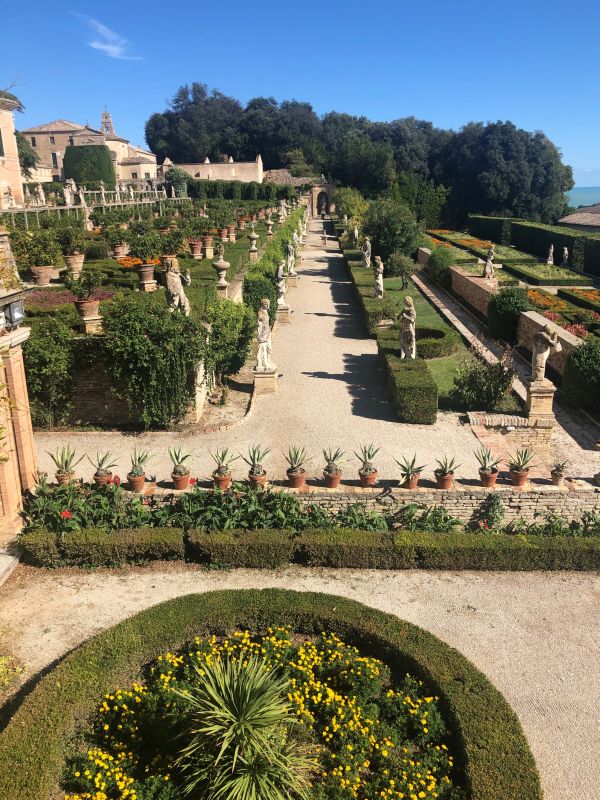
The villa dates back to the early decades of the 1800s and is very run down. It has recently been acquired by a new owner who hopes to create a luxury hotel and the cost of the restoration is estimated at €30 million! The garden has better stood the test of time. It is maintained by Attilio (who guided our visit) and a team of two others. It descends over several terraces to an enormous “limonaia”.

On each terrace flowering box parterres are interspersed with fountains and terracotta vases dating as far back as 1870 which are planted with lemons. 150 or so mannerist statues of dwarves and other grotesque figures line the paths and there are numerous water games which still function. The views over the surrounding Marche hills are gorgeous.

After our visit we made our way across country to Recanati. Here were born Giacomo Leopardi one of Italy’s greatest poets and Beniamino Gigli one of the world’s greatest opera singers and our guided walking tour of the city was enlivened by tales of both personalities. Good fortune meant that our event was just one week after the inauguration of FAI’s newly-restored Orto sul Colle dell’Infinito.

The garden is new but we liked the plant selection and, given the Giacomo Leopardi connection (the view from the garden inspired his most famous poem “L’Infinito”, written exactly 100 years ago), the place was steeped in atmosphere.

The next day Anna Maria Dalla Casapiccola hosted our event at her historic “dimora” Palazzo della Casapiccola and guided us around its charming garden. Then followed a talk by international florist Ercole Morroni originally from nearby Senigallia. He gave us tips on colour and flower combinations in both gardens and floral arrangements, and much else. We finished with our usual exchange of plants.

September 2019
"Un Viaggio nei giardini d’Europa" - Exhibition and Garden Visit, La Venaria Reale(TO)
Members travelled to La Venaria Reale near Turin to enjoy a unique visit to the exciting exhibition"Un Viaggio nei Giardini D'Europa"guided by curator Professor Paolo Cornaglia.

Across the centuries, architects and landscape designers, aristocrats and royalty, writers, intellectuals and scholars travelled across Europe to visit gardens, admire landscapes and draw inspiration from them. This exhibition brings together more than 200 exhibits including notebooks, diaries, garden plans, models and paintings to give a fascinating insight into changing garden fashions in Europe from the 15th to the 20th centuries.

We also visited the extensive and beautiful palace gardens with the Director of Gardens Maurizio Reggi who shared with us the philosophy behind the choices made in the mega restoration of the 80-hectare gardens.


Abandoned as a royal palace in the early 19th century and reduced by 1996 to total decay, the gardens now combine design elements drawn from the palace’s 16th 17th and 18th century historic archives with modern plantings to give visitors a wonderful taste of the garden of old.
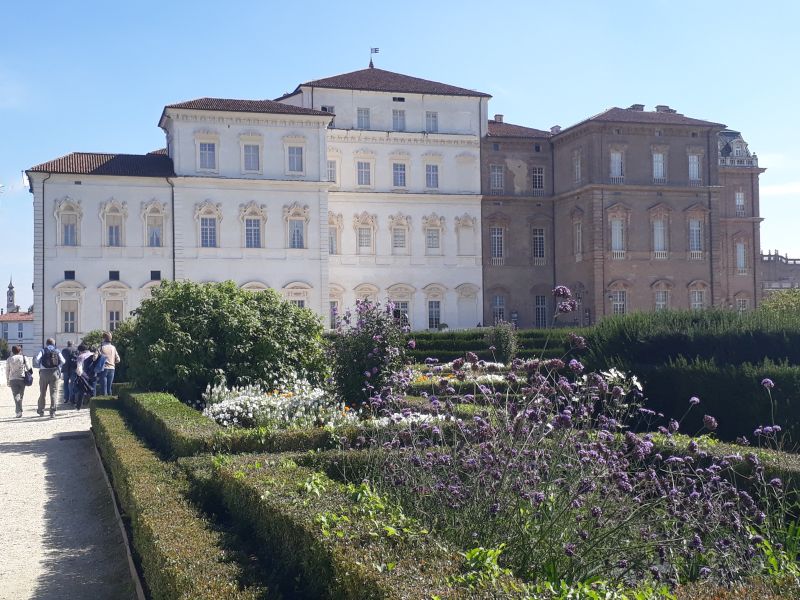


May 2019
Todi Gardens
Members enjoyed the magnificent countryside of Umbria while visiting two beautiful private gardens both set off to perfection by the surrounding hills and views.
The first garden of about 4500 square meters has been created over many years with passion and hard work by a husband and wife team who care for the garden themselves. It was truly inspirational to participants as it puts into practice many of the gardening principles promoted by the society in an original and beautiful way.

Started in 1983 the garden benefits from plenty of shade created by a canopy of larger trees and an understory of mid-size Mediterranean natives plus various garden structures which protect and encourage abundant ground level plantings.


Shrubs and perennials have been packed tightly together to save on evaporation and to keep out unwanted weeds. Everywhere desirable weeds, together with garden plants who have self-seeded in unplanned places, are left undisturbed and add amiable disorder to a lush and verdant haven.
There were a couple of very small lawns near the house and ‘lawn alternative’ grass around the swimming pool but elsewhere gravel has been used between plantings.

All of the paths were laid out and constructed by the owners themselves and along them are dotted lovely home-fashioned garden seats which invite one to rest.

There seemed no end to our delight as winding paths led us on and on to yet more plant-packed beds.

The second visit of the day provided a total contrast. This was a professionally-designed, modern, architectural garden created around a new home with ambitious ecological credentials (green roof, geothermal heat pump, photovoltaic panels, solar tube lighting, vertical water treatment plant). Set high up on a hillside with magnificent views over the countryside the garden invites you in with sweeping views to the woods on the left and to the house in front.
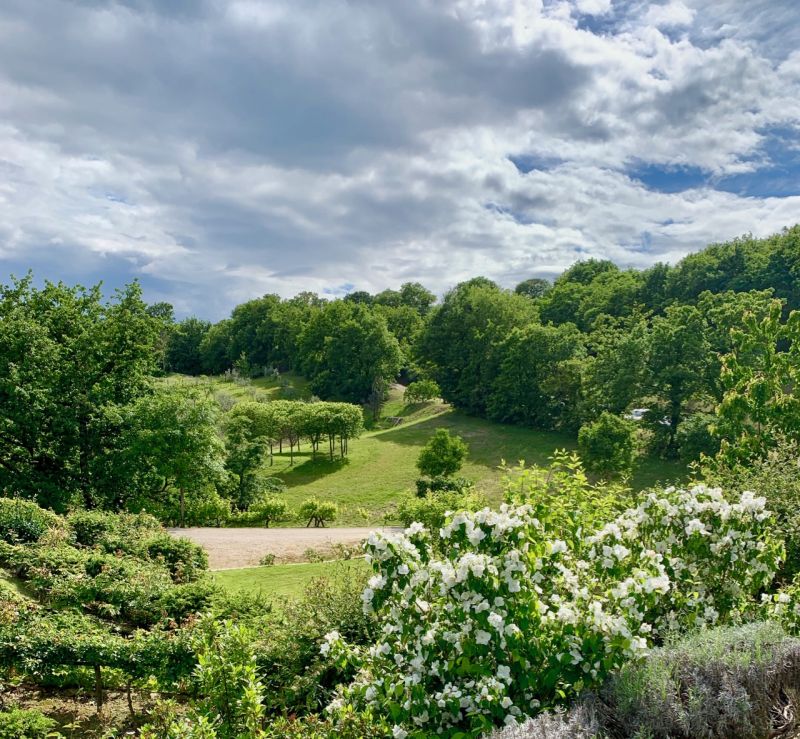
Along the drive several Fraxinus ornus trees are linked by garlands of vines – a customary agricultural feature from times gone by. All rainwater is conserved in huge underground cisterns but well water also serves for irrigation. Moving out from the house are planted swathes of repeating mediterranean natives (Elaeagnus ebbingei, both Phillyrea angustifolia and latifolia, Pistacia lentiscus plus several Cistus varietals) interspersed with sweeps of lawn.

The transition thereafter out towards the surrounding woodland has been managed by re-creating a woodland edge with a mixed hedge comprised of all the plants that would normally be found in nature: Rosa canina (dog rose), Spartium junceum (Spanish broom), Crataegus monogyna (common hawthorn), Prunus spinosa (blackthorn or sloe) and Cornus sanguinea (common dogwood).

May 2019
Gardens of Springtime Florence
An enticing programme which started with a visit to both art collection and garden at Villa La Pietra. The garden is one of the most celebrated in Italy. A renaissance revival garden, it reflects the tastes of the large Anglo-American community that lived in Florence at the turn of the nineteenth century. Laid out by the Acton family from 1908 until the outbreak of the second world war, the garden’s design is much influenced by original Renaissance gardens of Florence although it also contains elements reflecting later gardening fashions. The priceless Acton Collection decorates the interior of Villa La Pietra with more than 6000 objects from a wide range of styles and media (no photos were permitted).


The following day we were accompanied by Count Torrigiani in his wonderful garden at Villa Torregiani. At 10 hectares this is the largest private garden in the world within the bounds of a walled city.


It features a romantic 19th century English Garden complete with mature trees, spreading lawns and various follies topped by a 40m-tall tower – symbol of the family. Then, as was the fashion, there is also an Italian garden with antique greenhouse of over 200 square meters and a pretty parterre garden in front of it.


Transferring to Piazzale Michelangelo (and the classic view of Florence’s Cathedral) we then walked back down to the city first through the Giardino dell’Iris where magnificent varietals of iris - entrants to the annual international competition which has been held here since 1954 - are planted in beds organized by year. Then still further down through the Giardino delle Rose– magnificent in May bloom.

After lunch in the historic quarter of San Niccolò we were accompanied by a landscape architect on our afternoon visits. First to the recently restored gardens at Villa Bardini, worth a visit for the views of Florence alone, it is a steeply terraced late-18th century garden, replete with statuary, an Anglo-Chinese garden and more horticultural interest than at most historic Italian gardens. We enjoyed the collection of irises lining the baroque staircase and the wisteria tunnel underplanted with 60 varieties of hydrangea.


On foot we then proceeded to the Giardini di Boboli to appreciate highlights of one of the first and most important examples of the "Italian Garden”. Originally designed for the Medici, Boboli served as inspiration for many European courts and in particular, Versailles. The park hosts centuries-old oak trees, fountains, mazes and statuary both ancient and Renaissance. Particularly beautiful the Grotto created by Buontalento – a mannerist masterpiece.

April 2019
Gardens, Landscapes and History of the Bay of Naples
MGS Italy and numerous members from other branches enjoyed five days of visits in the Bay of Naples area. Based in Sorrento, the tour included botanical, historic, romantic, private and productive gardens plus several historic attractions.
On the island of Capri we walked on Monte Solaro, visited San Michele Church, enjoyed lunch on the terrace at Axel Munthe’s masterpiece Villa San Michele and savored the verdant silence of the thirteenth-century Certosa di San Giacomo.


A day on the Sorrento peninsula featured a visit to a centuries-old productive lemon grove “Giardino Il Vigliano” and a nature walk on Punta Campanella with wild orchids, asphodels, cistus, broom and magnificent views over the Bay of Ieranto.


Next up was a panoramic drive along the Amalfi Coast, a vertical landscape between mountain and sea and the very essence of “mediterranean”. We left the coast to arrive to romantic, cliff-top Ravello and visited the gardens at Villa Cimbrone and Villa Rufolo. On our way home we crossed the Monte Lattari mountain range, dropping in to visit “Il Giardino Segreto dell’Anima” en-route.


Two days of visits in the Vesuvius area focused on the legacy of Roman nobles and Bourbon kings. They included the Pompei UNESCO ruins, the stunning Villa Di Poppea at Opplontis, the Royal Palace at Portici with its historic botanic garden and Villa Campioleto one of the Vesuvian Villas on the Golden Mile from the Bourbon era.


October 2018
Branch Annual Meeting and Plant Exchange, Torre di Sopra, Bagno a Ripoli (FI)
This year’s venue for our Branch Annual Meeting and Plant exchange was Torre di Sopra (the Tower Above), Italy Branch member Jane Sacchi’s magnificent and unusual medieval property lying 10km to the south of Florence around which she has developed a lovely garden. Low hedges of bay, oak, oleaster and rosemary are clipped to form clean horizontal lines and within these olive trees, vines and fruit trees flourish. Flowering shrubs – salvia, catmint, rosemary, agapanthus, cosmos - in blues, oranges and whites provided color accents which are repeated in the interior decorations with exquisite taste. The vegetable garden, in a beautifully-constructed medieval layout, provides ample vegetables all year round and is much loved by guests, family and friends. The garden provides a perfect setting for the house and tower and a glorious place to sit and enjoy magnificent views over Tuscany and the city of Florence.
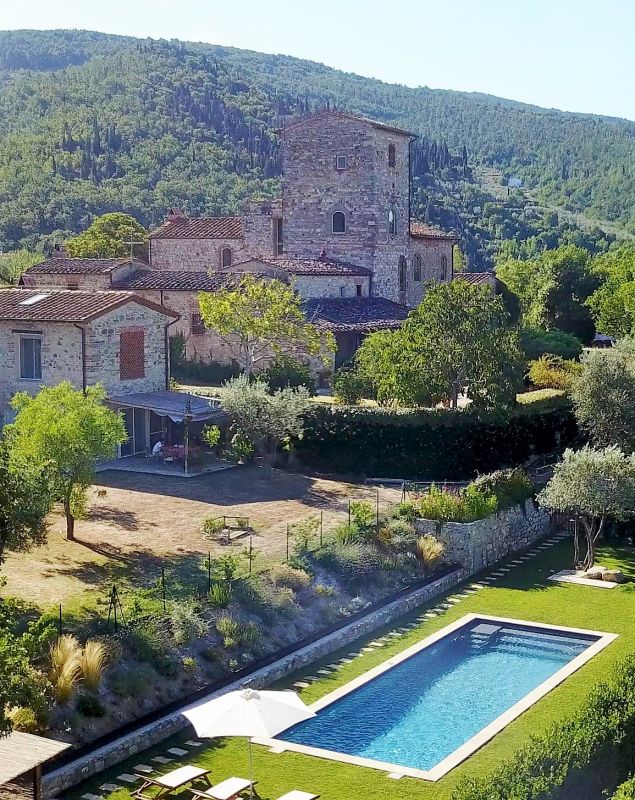


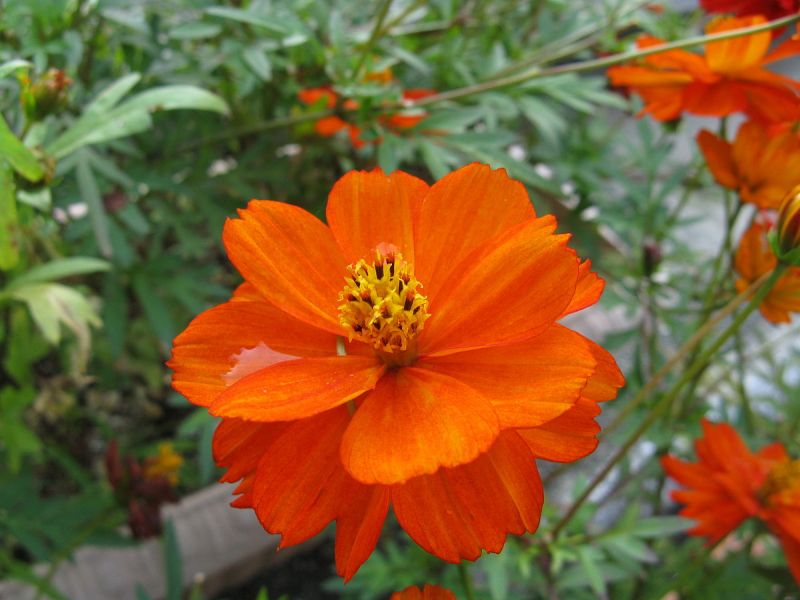


September 2018
Palaces and Historic Gardens in and around Caserta
A delightful two-day itinerary around our visit to one of the marvels of Italy – La Reggia di Caserta -included two other private historical residences and gardens in the area: the Giardino Dei Duchi Guevara di Bovino with its Italianate and English gardens (which features in the book “Italy’s Best Gardens”) and Palazzo Mondo with its stunning art, exquisite interiors and historic courtyard garden typical of Southern Italy.
We began however with an interesting visit to Casino Reale del Belvedere and Museo della Seta at San Leucio where we encountered the old looms of the silk factory and visited the royal apartments where the vast marble bath in beautifully-frescoed bathroom of Maria Carolina impressed us.
The Garden of the Dukes Guevara di Bovino was built in 1781 by Annamaria Suardo Guevara, Duchess of Bovino. It extends for 1.7 hectares and is designed in part with avenues with shaped hedges in the Italianate style and in part with an ancient oak forest, originally intended for hunting and then converted in the late '700 into a romantic walk.
At the Reggia di Caserta we started with a visit to the Royal Palace, one of the largest and most majestic buildings in Europe (1200 rooms served by 34 stairs and 1970 windows), the masterpiece of the architect Luigi Vanvitelli. On the ground floor, the elegant and harmonious Court Theatre was a particular delight.

Inside, the grand staircase to the first floor is surmounted by a double elliptical vault in which musicians were placed to greet the arrival of the King and his guests.

We proceeded from there to the beautiful Palatina Chapel and the sumptuous Royal Apartments with rooms full of furniture and decorations from the 1700s and 1800s.
Once outside in the Royal Park, our horse and carriage ride allowed us to visit a little-known area of the Park, the Royal Forest. Here was a large fishing lake with a wooded island in the middle, and deep in the trees is the Torre Prenesta or Castelluccia, an octagonal building surrounded by a moat, built for education and recreation of the young Princes and Court.


The Italianate Park (covering over 120 hectares with a 3 km long central axis) has amazing water games, pools arranged at different heights and fountains that culminate with the Great Waterfall. The latter plunges 78 meters, framed by tall woodland, into a large basin enriched by a superb sculptural cycle depicting Diana surrounded by nymphs and dogs driving away Actaeon, who being transformed into a deer, is attacked by his own dogs.


Now on foot we encountered the English Garden, located in the western part of the park, constructed by the English botanist G. Andrew Graefer on behalf of Queen Maria Carolina, under the supervision of Carlo Vanvitelli who succeeded his father. The garden occupies an area of over 25 hectares and has ancient trees, ponds, rare plants and ancient greenhouses. There we admired the archaeological remains from the excavations of Pompeii and other picturesque artificial ruins. A most beautiful feature was the statue of Venus kneeling on a rock surrounded by a tranquil pond.
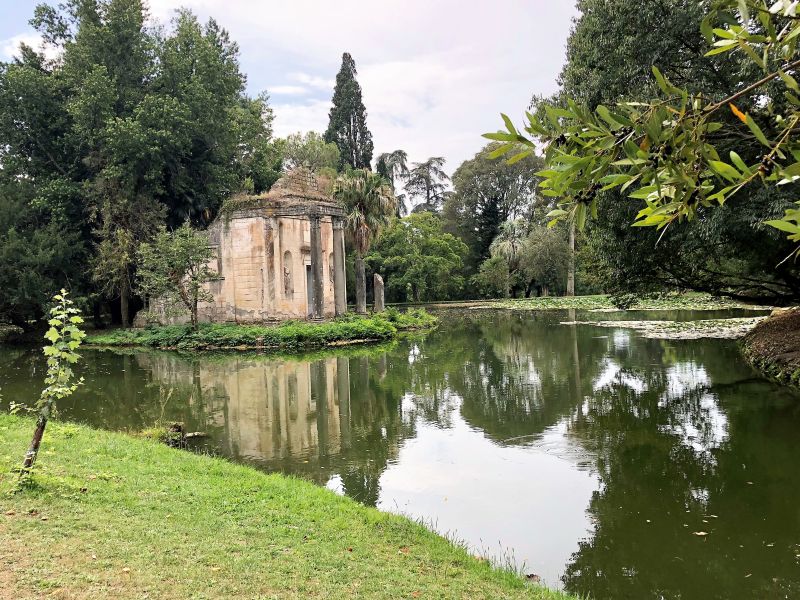
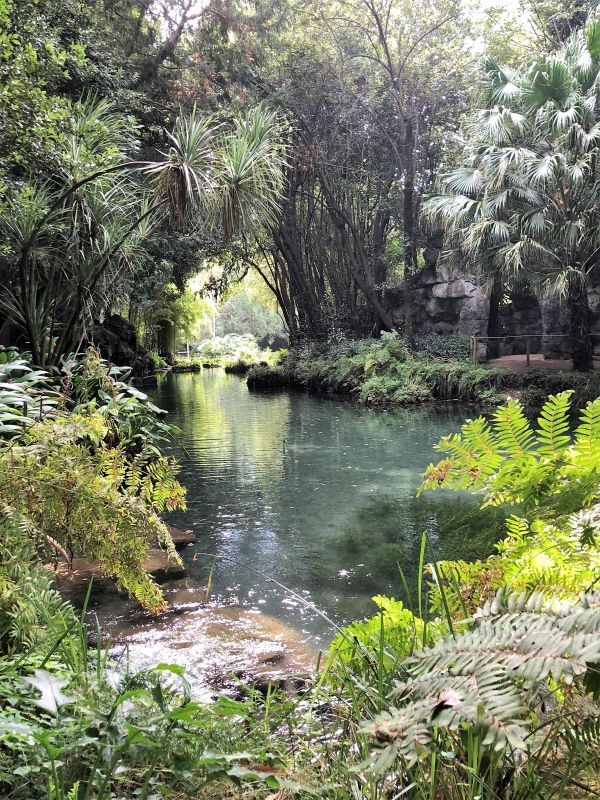

Originally all water features in the park were supplied by Carolino Aqueduct, 40 km long and traversing five mountains, designed by Luigi Vanvitelli himself based on the architectural model of the Roman aqueducts. Today water from the aqueduct is diverted to the town of Caserta and the fountains and pools function on pumps and recycled water.
Palazzo Mondo: we lunched downstairs before visiting the historic first floor apartment which is now preserved as a house-museum dedicated to the ‘fresco’ painter Domenico Mondo. The delightful courtyard garden is enclosed by high walls of tufa and shaded by Aralia papyrifera. Oranges and tangerines, laurel and philadelphus plus climbers of jasmine and clematis give perfume and form while the loggia where we had our coffees was dripping in strawberry grapes.

Our trip was organized in collaboration with the cultural association GIA.D.A (Giardini e Dimore dell’Armonia) which was founded to preserve and promote historical gardens and villas in the area.
Photographs by Sergio Ungaro
May 2018
Assisi: In the footsteps of Saint Francis
We started our day with a guided visit to the specialist rose nursery ‘Quando Fioriranno Le Rose’ set against the stunning backdrop of Assisi.
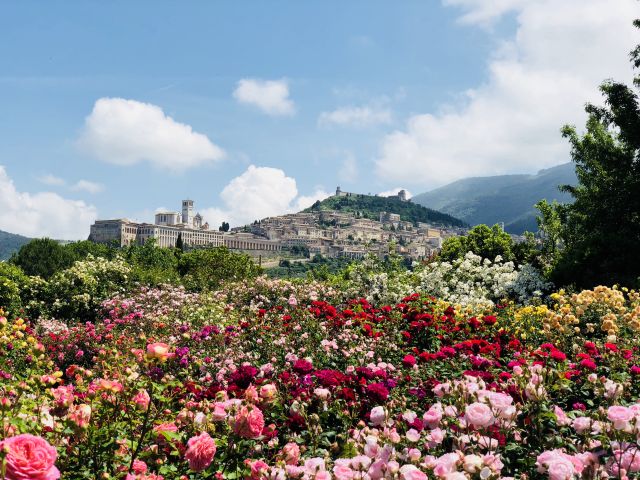
The name of thenurserycomes from a story about St Francis. He went to visit Saint Clare in her convent in the town of Assisi during winter with snow on the ground. As he was leaving, she asked him when he would return. His reply was Quando fioriranno le rose (‘when the roses bloom’), upon which roses grew up out of the snow and came into bloom and Saint Clare presented him with a bouquet of them.
Owned by Paola Bianchi and run together with her husband Fabio who is also a professional photographer, the nursery features a rose garden full of antique and English roses which have been selected for multiple flowering, colour and fragrance. The guided visit was an excellent way to develop our knowledge of roses and to get to know some stunning varieties.
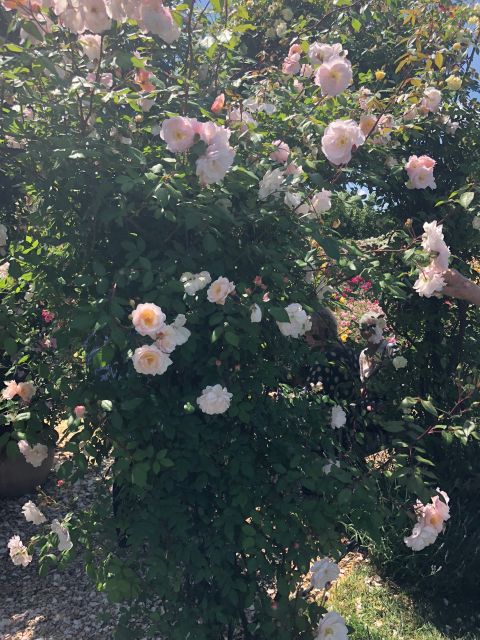
We then moved to the Bosco di San Francesco. While the Basilica of Saint Francis of Assisi is no doubt one of Assisi’s major attractions, few know of the nearby woods or venture along the trails where Francis himself and his friars walked in nature and dedicated themselves to contemplation.

After a light lunch we enjoyed a guided tour of the complex by the resident head gardener. We visited the garden around the ancient Benedictine monastery and the historic woodland park recently restored by FAI (Fondo Ambiente Italiano). Our walk was followed by an interesting presentation of traditional cooking from the time of the Benedictine sisters (1200-1300) to today.
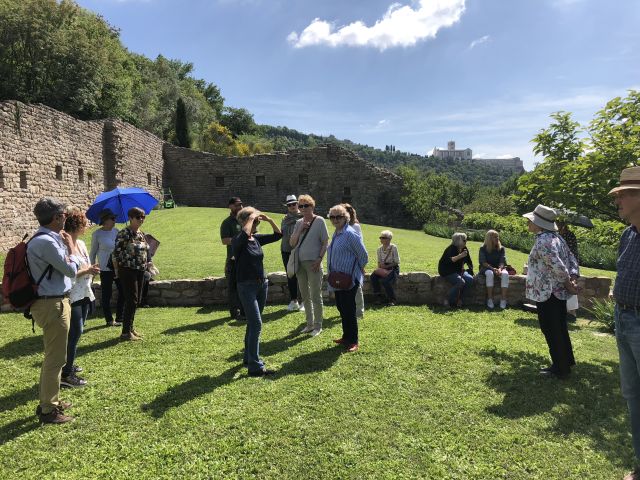
For older reports and articles please check out the archived (non-responsive) Italian Branch page.
Branch Head, Angela Durnford writes "I am English – born in Kenya and educated in the UK - and I lived and worked in London for many years marketing for organizations such as Amex, the BBC, the FT and The Economist. I met my husband Sergio and moved to Italy in 1996. In 2004 we bought and restructured our house in Montemarcello (SP) on the west coast of Italy in the bay of La Spezia and I began working on the garden, which is dominated by a magnificent view over the bay and the Montemarcello Regional Park. The plot is about a hectare with half given over to olives, and we produce about 150 litres of punchy, green oil every other year. At the beginning I knew very little indeed, but I was fortunate to receive a copy of Heidi Gildemeister’s book Mediterranean Gardening as a gift, and so began my gardening journey…"
THE MEDITERRANEAN GARDEN is the registered trademark of The Mediterranean Garden Society in the European Union, Australia, and the United States of America
