Mediterranean Garden Society
Mediterranean Garden Society
The Sea Squill
by Matina Tsalouma
Photographs by Matina Tsalouma and Lucinda Willan
Photographs to illustrate the article published in The Mediterranean Garden No. 123, January 2026
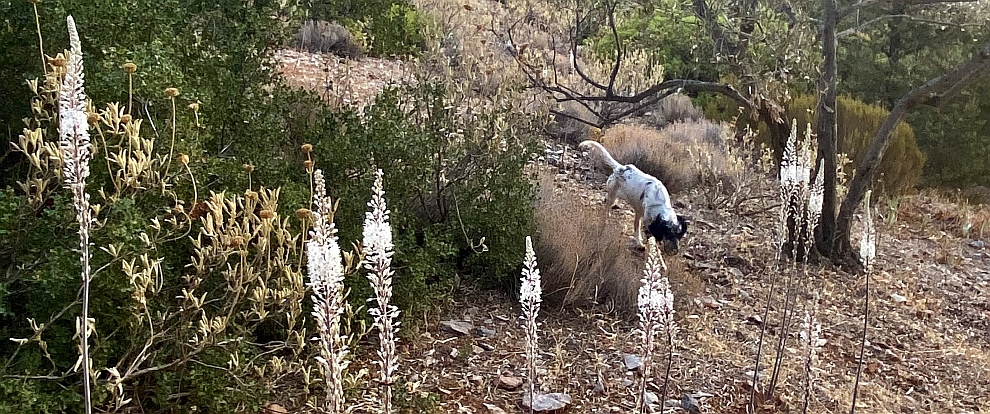
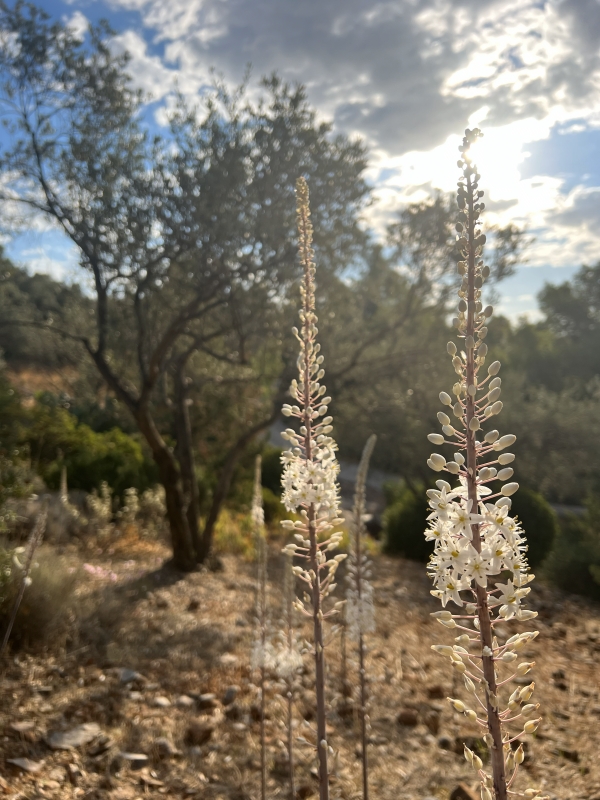
The photo at the top of this page shows Drimia maritima on the Hillside at Sparoza (Photo Lucinda Willan)
Matina Tsalouma writes: The sea squill is the commonest and most spectacular October wildflower to be seen on the Greek island of Leros. From about mid-September onwards, even before the first rains, it begins to appear in odd places. Within a few weeks it may be observed all over the dry rocky hillsides, at field margins and by the roadside, signalling the triumphant return of life after the long baking summer.
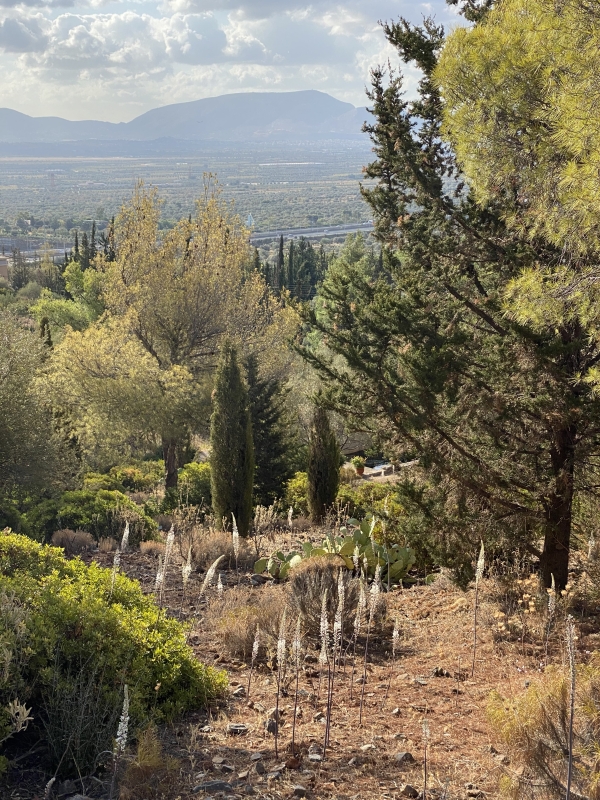
Let us take a closer look at this remarkable plant, a member of the Asparagus family. Its genus, Drimia, is a large one comprising about 100 species, three of which are native to Europe. In the Mediterranean Basin the species most often encountered is Drimia maritima. According to M. Panitsa and D. Tzanoudakis, researchers who have painstakingly catalogued the flora of Leros, this is the species we observe on our island*. Commonly referred to in English as the sea or scilla onion, the sea squill has had a confusing history of scientific name changes**. Found throughout the coastal regions of Greece it is typically known as σκιλλοκρομμύδα, but has also acquired numerous regional names, such as κεράκι (i.e. candle) as it is called here on Leros.
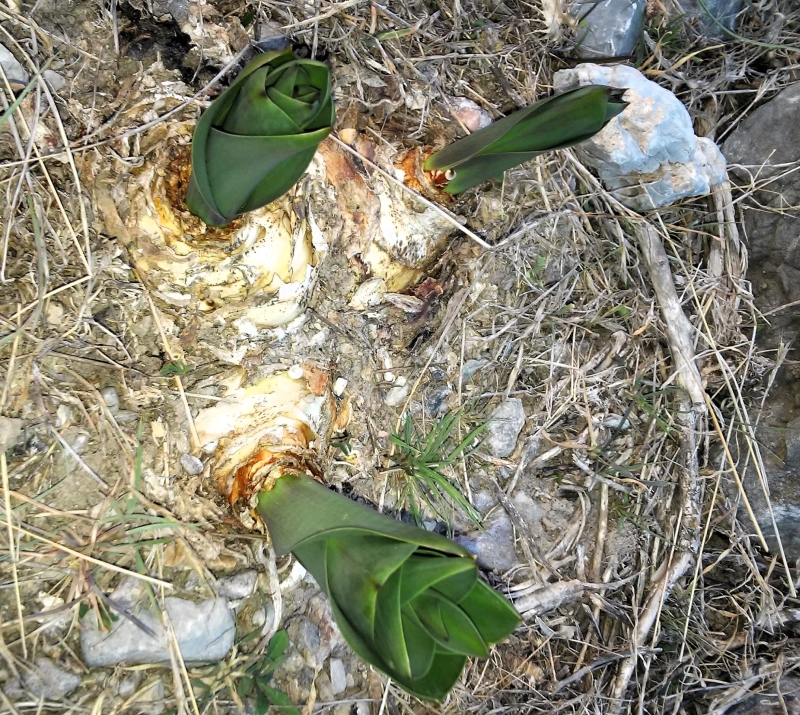
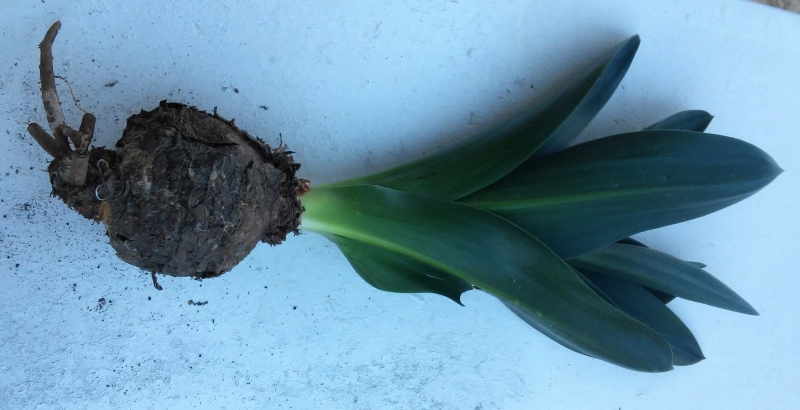
The sea squill has a large bulb, growing very close to the surface of the soil, quite often protruding through it. Bulbs are frequently found in clumps, brought about by natural division. The few parallel roots, which are thick, white and pudgy, grow downwards, deep into the earth. In late autumn the bulb puts out a rosette of long, shiny blunt-tipped leaves of a deep green colour. Most grazing animals avoid them because of their toxicity. These leafy bulbs are still sold as New Year good luck charms in the markets of Athens***. All around the Mediterranean the sea squill is associated with tradition and folklore. By late spring the leaves have withered and are no longer toxic. The sea squill gathers its moisture and nutrients within the bulb and hunkers down to rest for the summer.
In September a flower stalk emerges from each bulb as the plants enter their reproductive phase. The stalk has a greyish-lilac colour tinged with pink. It is covered with microscopic hairs which give it a suede-like texture. As it lengthens, reaching up to 1.5m in height, the tip develops into an elongated cylindrical inflorescence consisting of simple pinkish flower buds. Flowering commences at the lower end in groups of about 30 flowers at a time, and continues upwards until it reaches the stalk’s tip, which is waving delicately across the landscape. The flowers themselves are star-shaped, have six waxy-white petals, and give off a subtle sweet perfume.
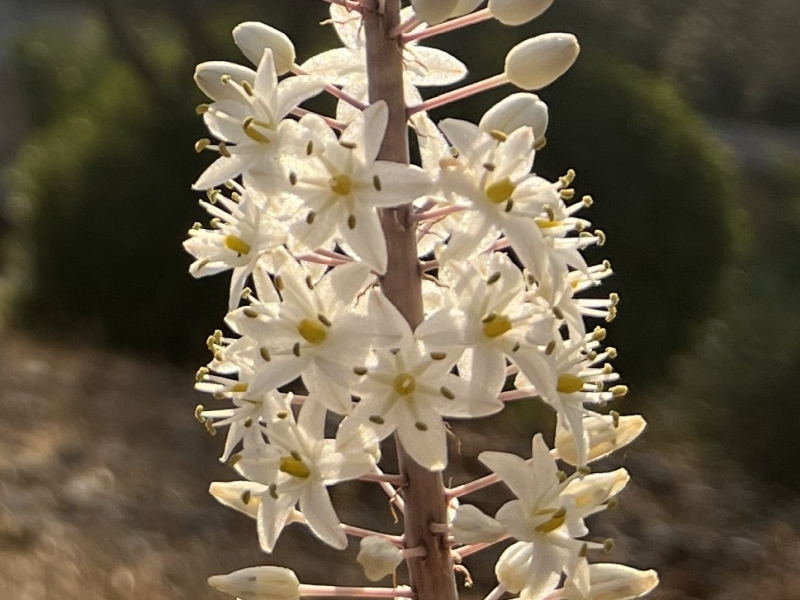
Close-up of Drimia maritima flower
On examination it will be seen that each petal has a prominent central vein. Characteristically, in Drimia maritima this vein retains the same colour as the petal but in other species it may be coloured differently. After pollination, either by bees or other insects or simply by the wind, the petals close up again to form seed capsules, which resemble the flower buds in form.
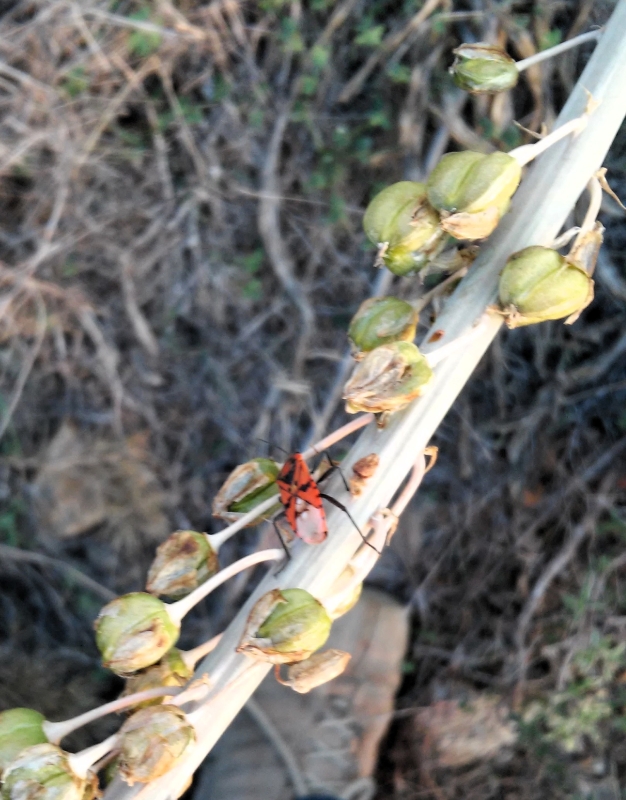
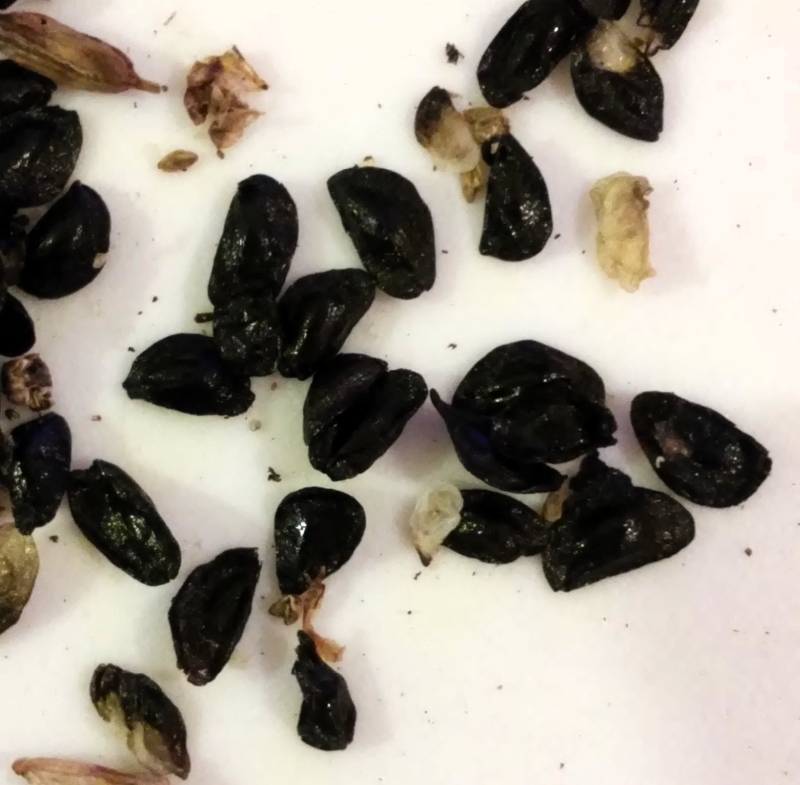
By November flowering is over. The seed capsules mature and scatter their seeds, while the stalk slowly withers. Soon the next set of leaves will emerge as a new annual cycle of growth begins. In this way it can be seen that the sea squill may have leaves or flowers, but never both at the same time. This is only one of the successful survival tactics developed by this particular plant in response to the harshness of its environment.
The sea squill is not only beautiful but also has powerful pharmaceutical properties, known since ancient times, and for which the bulbs are still cultivated commercially. It is, however, poisonous, and medications should be prepared only by professional herbalists.
On the island of Leros, as elsewhere, the natural environment is constantly shrinking. As habitats succumb to bulldozers and cement, so too do the natural flora and fauna. One thing that we can do to stem this tide of loss is to plant native species in our gardens. However, it is not a good idea simply to uproot native plants from the hillsides as this will only further deplete natural populations. Having said this, I should add that uprooted sea squill bulbs can often be found around building sites and roadworks.
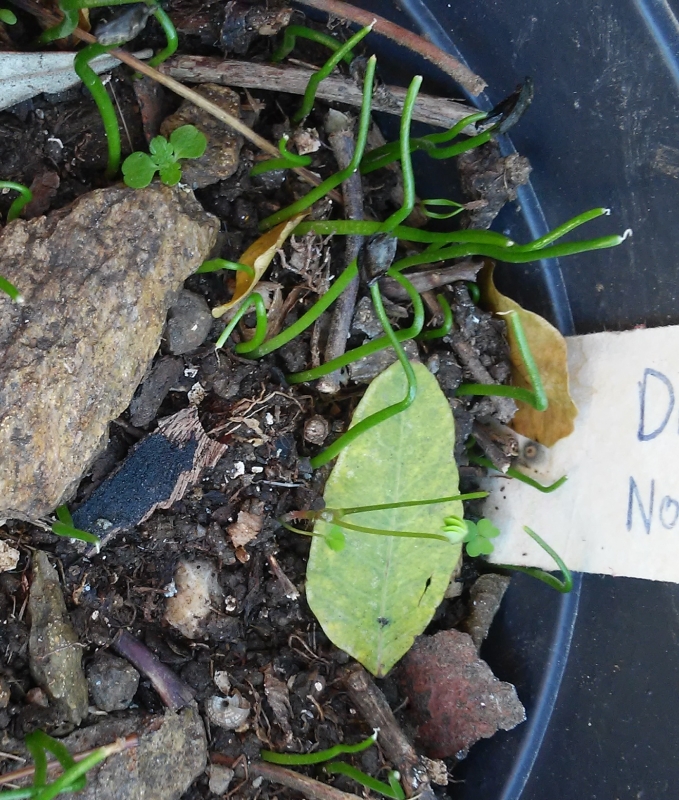
Fortunately, the sea squill is easily propagated by seed. Seeds may be collected as soon as the pods have dried up, around mid-November. They should then be sown into pots, at a depth of no more than 1cm below the soil surface. Ordinary garden soil can be used, once the stones have been removed, with some potting mix added. The seedlings soon appear, and by their second year will have developed small bulbs.
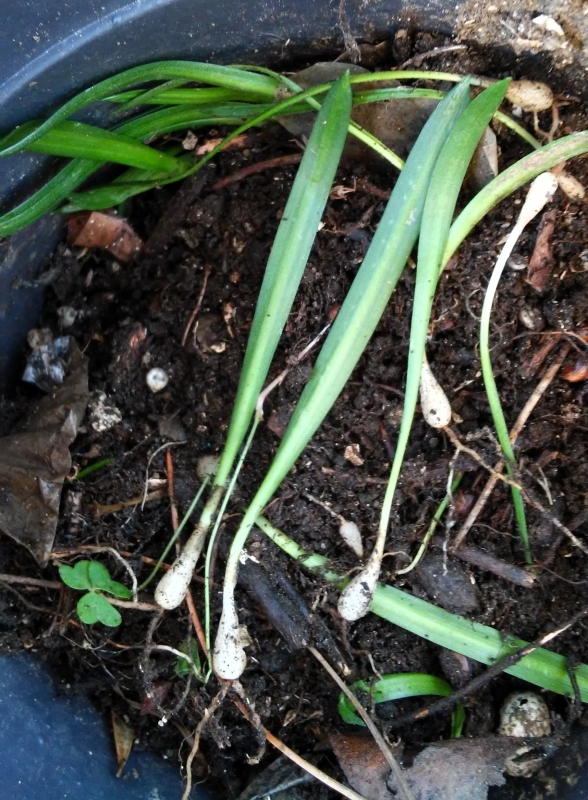
They may then be planted out in early autumn, but should be protected from digging animals at first, as they are very small. The sea squill does not require fertilisation or even watering; it is a trouble-free addition to the garden and provides a stunning and long-lasting display of flowers at a time when everything else is looking tired and dry. It will also attract bees. The sea squill can also be successfully grown in pots provided they receive ample sunlight.
A quick search on the internet will reveal many more fascinating facts about the sea squill. Some reliable sites used in the writing of this article were: kew.org, maltawildplants.com and wikipedia.com.
* Maria Panitsa & Dimitrios Tzanoudakis, Floristic diversity on small islands and islets: Leros islets’ group (East Aegean area, Greece), Phytologia Balcanica 16 (2): 271-284, Sofia, 2010.
** Some common synonyms are Urginea maritima, Charybdis maritima and Scilla maritima.
*** These good luck charms can be planted into pots once the festive season is over. In a sunny position they will flower in the following autumn.
THE MEDITERRANEAN GARDEN is the registered trademark of The Mediterranean Garden Society in the European Union, Australia, and the United States of America
website designed and maintained
by Hereford Web Design